Refrigerant leak repair cost
Updated 2026-11-07 · By the HVAC Service Estimator team
Fixr's 2026 data puts refrigerant leak repair at $200 to $1,600 with an average of about $800. Angi's figures put it at $250 to $1,500, with a recharge alone at $100 to $500, and Homeyou's 2026 data puts the average at $837 within a range of $479 to $1,389. The sources agree closely on the average and disagree on the edges - which tells you the typical job is roughly an $800 proposition and the outliers are what you need to understand.
What leak repair costs
Three published sources, three ranges, and an average they broadly agree on:
| Source | Figure | Scope |
|---|---|---|
| Fixr 2026 | $200-$1,600, average about $800 | Leak repair, central AC |
| Angi 2025 | $250-$1,500 | Leak repair |
| Angi 2025 | $100-$500 | Recharge only, no repair |
| Homeyou 2026 | Average $837, range $479-$1,389 | Leak repair |
| Fixr 2026, for context | Average AC repair about $375; most $250-$700 | All repair types |
The averages line up well - Fixr's roughly $800 and Homeyou's $837 are effectively the same answer. The ranges do not: Fixr's top end of $1,600 is higher than Angi's $1,500 and considerably higher than Homeyou's $1,389, while Homeyou's $479 floor is more than double Fixr's $200. That spread is not sloppiness in the data. It reflects how differently the same nominal job can play out depending on where the leak is, how long it takes to find, how much refrigerant the system holds, and which refrigerant that is. Plan around the $800-ish average, and understand which factors would push you to either end.
Why a leak is more than a hole
The refrigerant circuit is sealed by design. It is not a consumable, there is no reservoir, and a system that is low has lost charge somewhere. That makes a leak call three jobs stacked together: find it, fix it, and restore the charge correctly. Any one of them done badly wastes the other two.
Finding it
Common leak points are the Schrader valve cores at the service ports, brazed joints, the line set where it passes through a wall or rubs a support, the evaporator coil, and the condenser coil. Technicians locate them with an electronic leak detector, with soap bubbles on accessible joints, or with UV dye and a second visit after the dye has circulated. Dye is cheap but slow. A leak that takes two visits to find costs more in labor than a leak at an obvious service valve, which is a large part of why published ranges are so wide.
Fixing it
A leaking valve core is minutes of work. A leaking brazed joint means recovering the charge, cleaning the joint and re-brazing it under nitrogen so the tubing interior does not oxidize. A leaking line set may mean replacing a run of copper. A leaking coil usually means a new coil, because pinhole corrosion is rarely a single repairable spot. The repair difficulty, not the leak itself, sets the price.
Recharging it correctly
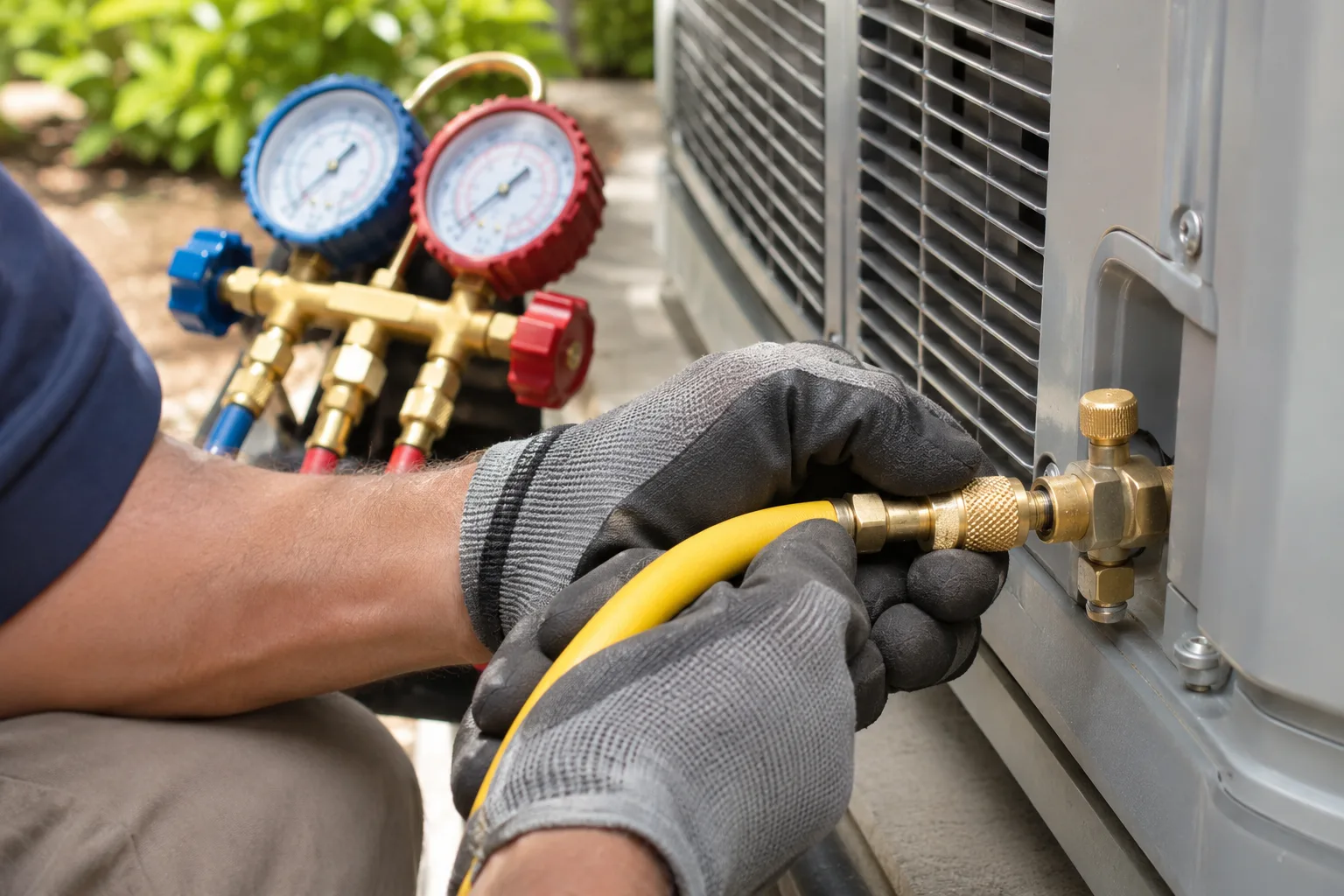
This is the step that separates competent work from guesswork, and it is the same discipline as any refrigerant circuit repair:
- Recover the remaining refrigerant into a recovery machine - venting it is both illegal and wasteful of something you already paid for
- Repair and replace the filter drier, because the drier has been exposed to whatever moisture got in
- Braze under a nitrogen purge, then pressure-test with nitrogen to confirm the repair actually holds
- Evacuate to roughly 500 microns with a micron gauge, then close the valves and confirm the vacuum holds - that is the proof the system is both dry and tight
- Weigh in the charge to the nameplate value, then verify by superheat and subcooling
If the quote does not include a new filter drier and an evacuation, ask why. Moisture left in a refrigerant circuit forms acid and takes out the compressor later, which turns an $800 repair into the compressor job Angi prices at $800 to $3,000 and Homeyou at an average of $2,487.
Refrigerant type changes the math
Refrigerant is sold by the pound, so the number of pounds and the price per pound both matter. Which refrigerant you have decides whether a repair makes sense at all.
- R-410A - the standard in residential split systems for roughly the last fifteen years. Available, serviceable, and the normal case for leak repair.
- R-454B - what new equipment ships with as the lower-GWP replacement for R-410A. Mildly flammable, which means A2L-rated handling practices, and not interchangeable with R-410A.
- R-22 - in systems roughly pre-2010. No longer produced. The remaining supply is expensive, which makes recharging an R-22 system a bad place to put money even when the mechanical repair is trivial. On an R-22 system a confirmed leak is usually the signal to price AC replacement rather than repair.
Repair or replace?
A reasonable way to think about it, against the $3,900 to $7,900 that 2026 guides put on a central AC changeout:
- Repair when the leak is at an accessible joint or a valve, the system is on R-410A, and the equipment is relatively young.
- Think hard when the leak is in the evaporator coil, when this is the second leak in a few seasons, or when the system is twelve-plus years old.
- Replace when the system is R-22, when the leak is in a coil on old equipment, or when a leak repair arrives alongside a failing compressor.
Questions to ask before you approve the work
- Where exactly is the leak, and how was it located?
- What refrigerant is in this system, how many pounds does it hold, and what is the per-pound price?
- Is a new filter drier included?
- Will the repair be nitrogen pressure-tested and the system evacuated with a micron gauge?
- Will the charge be weighed in, and will you leave me the superheat and subcooling readings?
- If this is a top-off rather than a repair, say so in writing, and what does the real repair cost?
With HVAC Service Estimator HVAC+ you can itemize diagnostic time, leak-search labor, the repair itself, the filter drier and refrigerant by the pound at local rates - which makes it easy to spot a quote that charges for a recharge and calls it a repair. See AC repair cost for how this fits against other common failures. An app estimate is informational, not a bid.
Frequently asked questions
Can a technician just add refrigerant instead of fixing the leak?
They can, and Angi puts a recharge alone at $100 to $500, but a sealed refrigeration circuit does not consume refrigerant. If the charge is low, it escaped. Recharging without finding the leak means you pay for the refrigerant now and pay for it again next season, and running a system undercharged in the meantime is hard on the compressor. A top-off is a defensible stopgap in the middle of a heat wave if the technician says so plainly and schedules the real repair. It is not a repair.
Why does refrigerant cost so much?
It is sold by the pound and the price depends heavily on the type. R-410A is the common refrigerant in existing residential systems. R-454B is what new equipment ships with. R-22, used in systems roughly pre-2010, is no longer produced, so the remaining supply commands a premium - which is why a leak on an R-22 system often makes like-for-like repair impractical even when the mechanical fix itself is easy.
Is a leaking evaporator coil worth fixing?
Frequently not. Coil leaks are often pinhole corrosion spread across the coil rather than one repairable spot, so the fix is a new coil - an expensive part, and on older systems the matching replacement may no longer be made. Against a central AC replacement, which 2026 guides put at $3,900 to $7,900 installed, a coil replacement on a system past about a dozen years old is usually the moment to price a changeout.
How do I know if my AC is actually low on refrigerant?
You usually cannot tell from the symptoms, which is the trap. Weak cooling, a frosted indoor coil and low suction pressure all occur with a dirty filter or a dirty evaporator coil too, because both restrict airflow. A proper diagnosis measures superheat and subcooling, checks the temperature split across the coil, and checks static pressure and airflow before anyone concludes the charge is low.
Sources
- Fixr - Central air conditioner repair cost (2026)
- Angi - AC Freon leak repair cost
- Angi - How much does HVAC repair cost
- This Old House - Air conditioner repair cost
Get an estimate for your system
Snap the equipment and get an itemized estimate with equipment and labor in minutes.
More in repair costs