AC repair cost
Updated 2026-11-07 · By the HVAC Service Estimator team
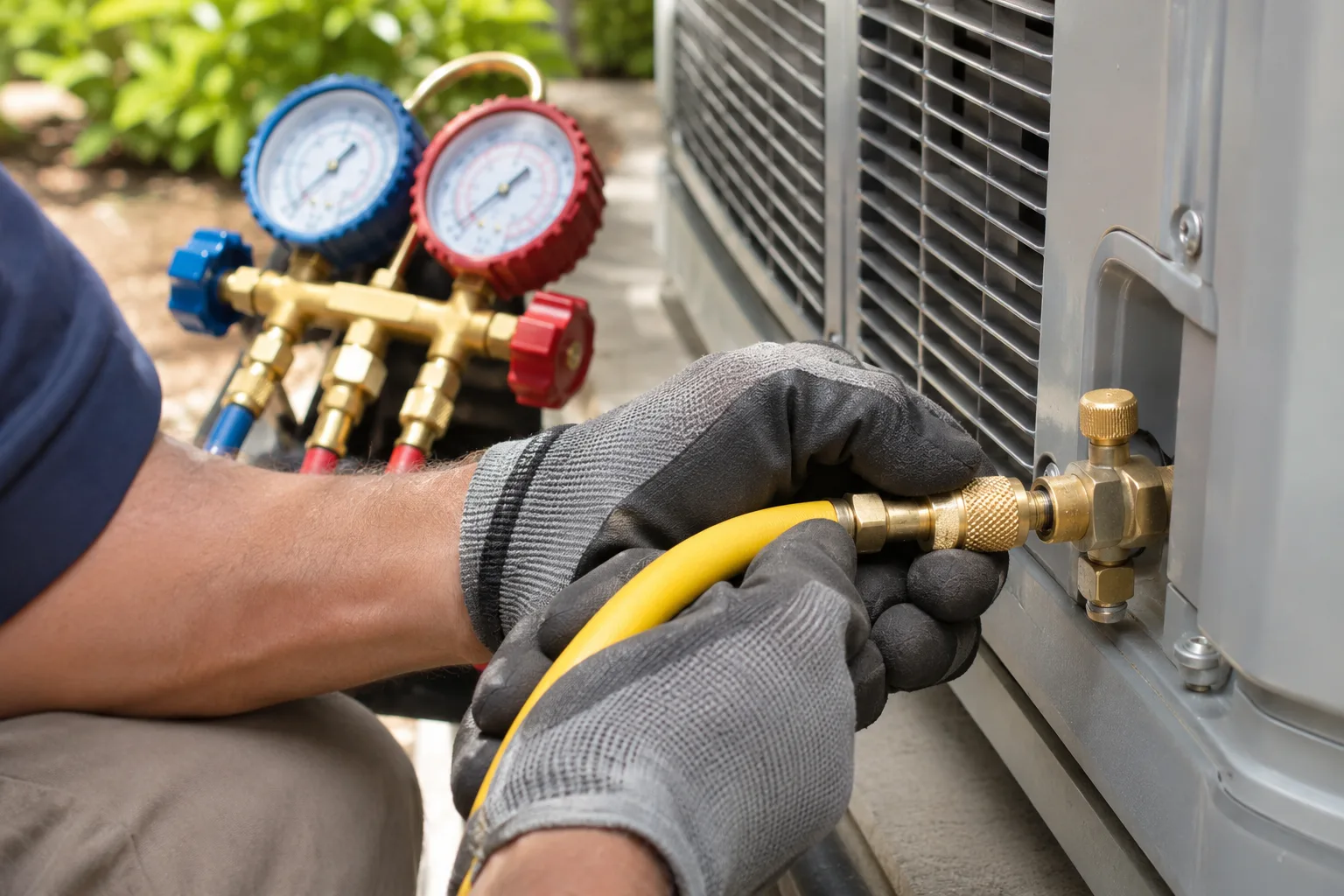
Fixr's 2026 data puts the average central air conditioner repair at about $375, with most repairs falling between $250 and $700. That average hides an enormous spread: a failed capacitor is a sub-$400 part swap, while a failed compressor is $800 to $3,000 or more and usually starts a conversation about replacing the system instead. What you actually pay depends almost entirely on which component died.
AC repair costs by failure
Every repair bill is the same two ingredients in different proportions: a part, which is a material cost, and labor, which includes the diagnostic time to find out what is wrong. On cheap electrical parts the labor dominates. On a compressor, the part dominates and the labor is still substantial because the refrigerant circuit has to be opened.
| Repair | Typical cost | Source |
|---|---|---|
| Average central AC repair, all types | About $375 | Fixr 2026 |
| Most repairs fall between | $250-$700 | Fixr 2026 |
| Run or start capacitor | $100-$400, average about $175 | Fixr 2026 |
| Capacitor, parts plus labor | $150-$400 | This Old House 2026 |
| Refrigerant recharge only | $100-$500 | Angi 2025 |
| Refrigerant leak repair | $200-$1,600, average about $800 | Fixr 2026 |
| Refrigerant leak repair | $250-$1,500 | Angi 2025 |
| Refrigerant leak repair, average | $837 ($479-$1,389) | Homeyou 2026 |
| Compressor replacement | $800-$3,000 | Angi 2025 |
| Compressor changeout, average | $2,487 ($1,679-$3,687) | Homeyou 2026 |
Two of those lines are worth flagging because the sources disagree. On refrigerant leaks, Fixr's average of about $800 and Homeyou's average of $837 agree closely, but their ranges do not - Fixr's top end is $1,600 while Homeyou's is $1,389 and Angi's is $1,500. On compressors the disagreement is larger and more consequential: Angi's $800 to $3,000 starts well below Homeyou's $1,679 floor. Both are published 2026-era figures. We give you both rather than averaging them into a number neither source supports.
The cheap repairs
Capacitor
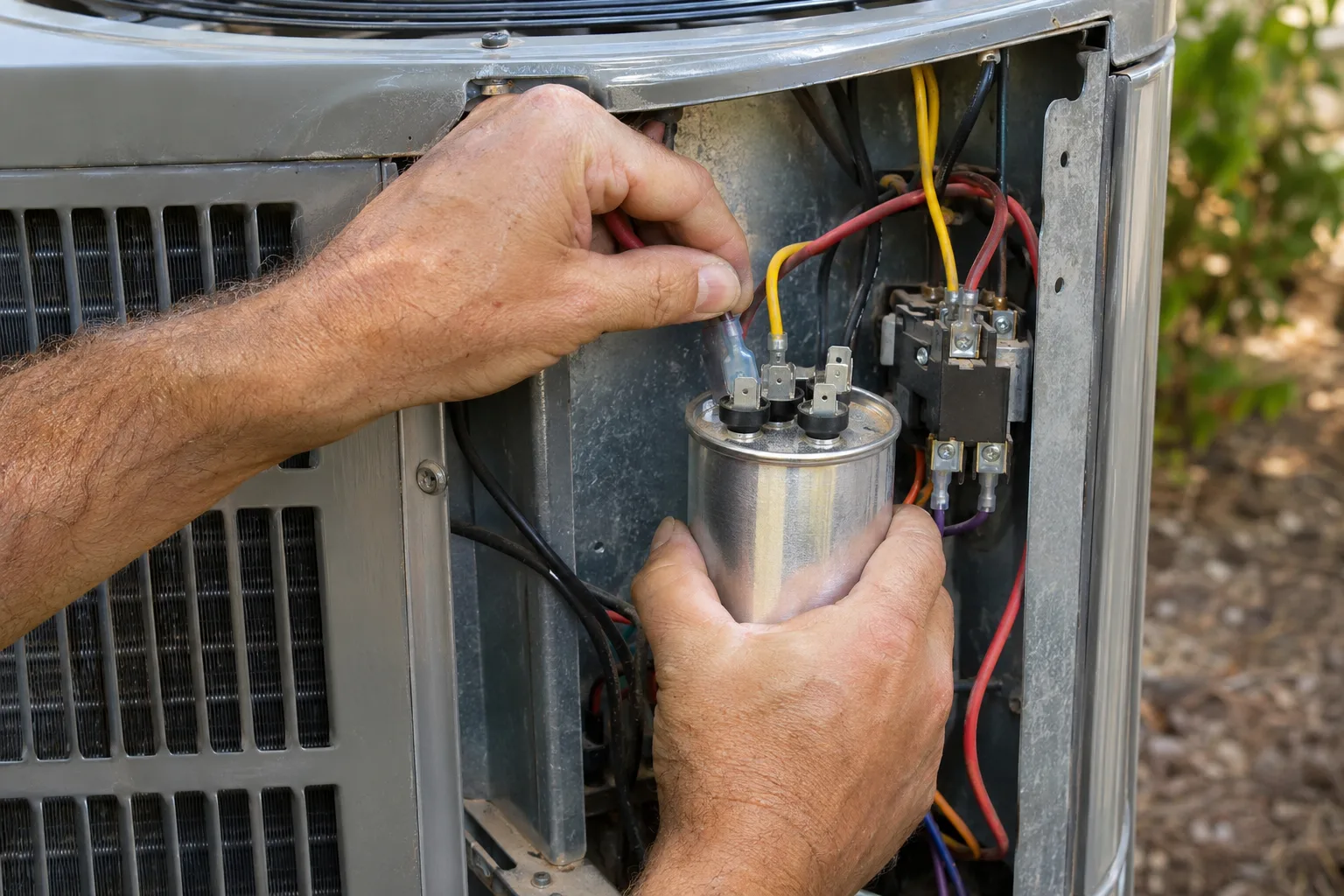
The single most common summer no-cool call. A run capacitor gives the compressor and fan motors the phase shift they need to start and run; when it weakens, the fan may spin but the compressor only hums and trips, or nothing starts at all. Fixr puts it at $100 to $400 with an average around $175, and This Old House at $150 to $400 parts and labor. It is a genuinely inexpensive repair and a legitimate one. See AC capacitor replacement cost.
Contactor, relays and controls
The contactor is the heavy relay that switches line voltage to the compressor. Pitted or welded contacts are a routine failure and a routine part. These repairs typically sit at the low end of Fixr's $250 to $700 band because the parts are inexpensive and the access is easy.
Clogged condensate drain and float switch trips
A plugged drain backs water into the pan, the float switch does its job and shuts the system off. Clearing it is a short visit. If a technician blames the float switch rather than the drain, they have the diagnosis backwards.
The expensive repairs
Refrigerant leaks
A sealed system does not use refrigerant. If the charge is low, something is leaking, and the honest repair is to find it, fix it, and then recharge by weight. Refrigerant is priced by the pound and the type matters: R-410A on existing systems, R-454B on new equipment, and R-22 on anything roughly pre-2010, which is where this gets expensive. R-22 is no longer produced; what remains costs a premium, which makes a like-for-like repair on an R-22 system impractical even when the mechanical repair itself is simple. Fixr puts leak repair at $200 to $1,600 with an average of about $800, Angi at $250 to $1,500, and Homeyou at an average of $837. See refrigerant leak repair cost.
Compressor
The compressor is the most expensive single component in the system and replacing it means opening the refrigerant circuit, recovering the charge, cutting the old one out, brazing the new one in, replacing the filter drier, evacuating to roughly 500 microns and weighing in a full charge. Angi puts it at $800 to $3,000; Homeyou's 2026 data puts the changeout at $1,679 to $3,687 averaging $2,487. Either way, on a system over about a dozen years old this is where a repair bill starts to look like a down payment on a new system. See AC compressor replacement cost.
Evaporator or condenser coil
A leaking coil is effectively a refrigerant leak you cannot patch. Coils are expensive parts and on older systems the matching replacement coil may not exist. This failure routinely tips the decision toward AC replacement, where 2026 guides put the cooling side at $3,900 to $7,900 installed.
What a good diagnosis looks like
Before anyone quotes you a part, the system should have been measured. Ask what was checked:
- Line voltage and control voltage, capacitor microfarads against the rating, contactor condition
- Suction and liquid pressures, with superheat and subcooling calculated - not just "the pressures looked low"
- Return and supply air temperatures, and the temperature split across the coil
- Total external static pressure and a look at the filter and the coil, because dirty-coil and low-airflow symptoms imitate a low charge almost exactly
- Amp draw on the compressor and the condenser fan motor
The reason this matters financially: a dirty evaporator coil and a restricted filter produce low suction pressure, ice on the coil, and poor cooling - the same picture as a low charge. A technician who adds refrigerant to a system that was actually starved for airflow has overcharged it and sold you refrigerant you did not need.
When to stop repairing
There is no universal formula, but three facts shift the decision:
- The refrigerant. If the nameplate says R-22, significant repairs are a dead end. The system cannot be economically recharged for the rest of its service life.
- The repair as a share of replacement. Against a $3,900 to $7,900 AC changeout, a $175 capacitor is trivial and a $2,487 compressor is not.
- Whether the furnace is also old. If both halves are near the end, doing them together avoids paying twice for the trip, the permit and the sheet metal. Angi's 2026 full-system average is about $7,500.
Before you call
Check the easy things first: the filter, the breaker, the thermostat batteries and settings, the outdoor unit for debris blocking airflow, and the condensate drain. Then write down the symptom precisely - whether the outdoor fan runs, whether the indoor blower runs, whether the coil is iced, and when it started. With HVAC Service Estimator HVAC+ you can itemize the suspected part, the labor and any refrigerant by the pound at local rates, so the quote you get has something to be compared against. Ask whether the diagnostic fee is credited toward the repair, and get the measured numbers, not just the verdict. An app estimate is informational, not a quote.
Frequently asked questions
What is the average cost of an AC repair?
Fixr's 2026 figures put the average central AC repair at about $375, with most repairs between $250 and $700. The average is useful for budgeting but not for predicting your bill - capacitor and contactor failures land well below it, while compressor and evaporator coil failures land far above it.
Why did my technician charge a diagnostic fee?
Because diagnosis is the work. Finding out why a system is not cooling means checking the power supply, the capacitor, the contactor, the charge by superheat and subcooling, the airflow, and the controls. A shop that charges nothing to diagnose is recovering that time somewhere else, usually in the repair price. Ask whether the diagnostic fee is credited against the repair if you approve it.
Is it worth repairing an AC that is 15 years old?
It depends entirely on the failure. A $200 capacitor on a 15-year-old unit that is otherwise running well is money well spent. A $2,500 compressor on the same unit is not, because you are putting a large fraction of a new system into equipment near the end of its life. If the system runs R-22, almost any significant repair is impractical, because the refrigerant is no longer produced and what remains is expensive.
My AC is low on refrigerant - can they just add more?
They can, but a sealed system does not consume refrigerant. If it is low, it leaked, and topping it off without finding the leak means paying for refrigerant that will escape again. Angi puts a recharge at $100 to $500 and leak repair at $250 to $1,500. A technician who recharges without looking for the leak is selling you the same refrigerant twice.
Sources
- Fixr - Central air conditioner repair cost (2026)
- This Old House - Air conditioner repair cost
- Angi - How much does HVAC repair cost
- Angi - AC Freon leak repair cost
- Thumbtack - Air conditioner repair cost
Get an estimate for your system
Snap the equipment and get an itemized estimate with equipment and labor in minutes.
More in repair costs