AC capacitor replacement cost
Updated 2026-11-07 · By the HVAC Service Estimator team
Replacing a run capacitor is the cheapest common air conditioning repair there is. Fixr's 2026 data puts it at $100 to $400 with an average of about $175, and This Old House puts it at $150 to $400 for parts plus labor. The part itself is inexpensive; most of what you pay is the trip and the diagnostic time. Against Fixr's overall average AC repair of about $375, a capacitor is a genuinely good outcome for a no-cool call.
What a capacitor replacement costs
| Source | Cost | Scope |
|---|---|---|
| Fixr 2026 | $100-$400, average about $175 | Capacitor replacement |
| This Old House 2026 | $150-$400 | Parts plus labor |
| Fixr 2026, for context | Average AC repair about $375 | All repair types |
| Fixr 2026, for context | Most repairs $250-$700 | All repair types |
The two sources agree closely. Fixr's lower floor of $100 and This Old House's $150 probably reflect different assumptions about whether a diagnostic or trip fee is bundled in. Both top out at $400, and Fixr's average of about $175 is the number to plan around. What you are mostly buying is the visit: the part is a commodity, and the value is in correctly identifying that the capacitor is what failed.
What the capacitor actually does
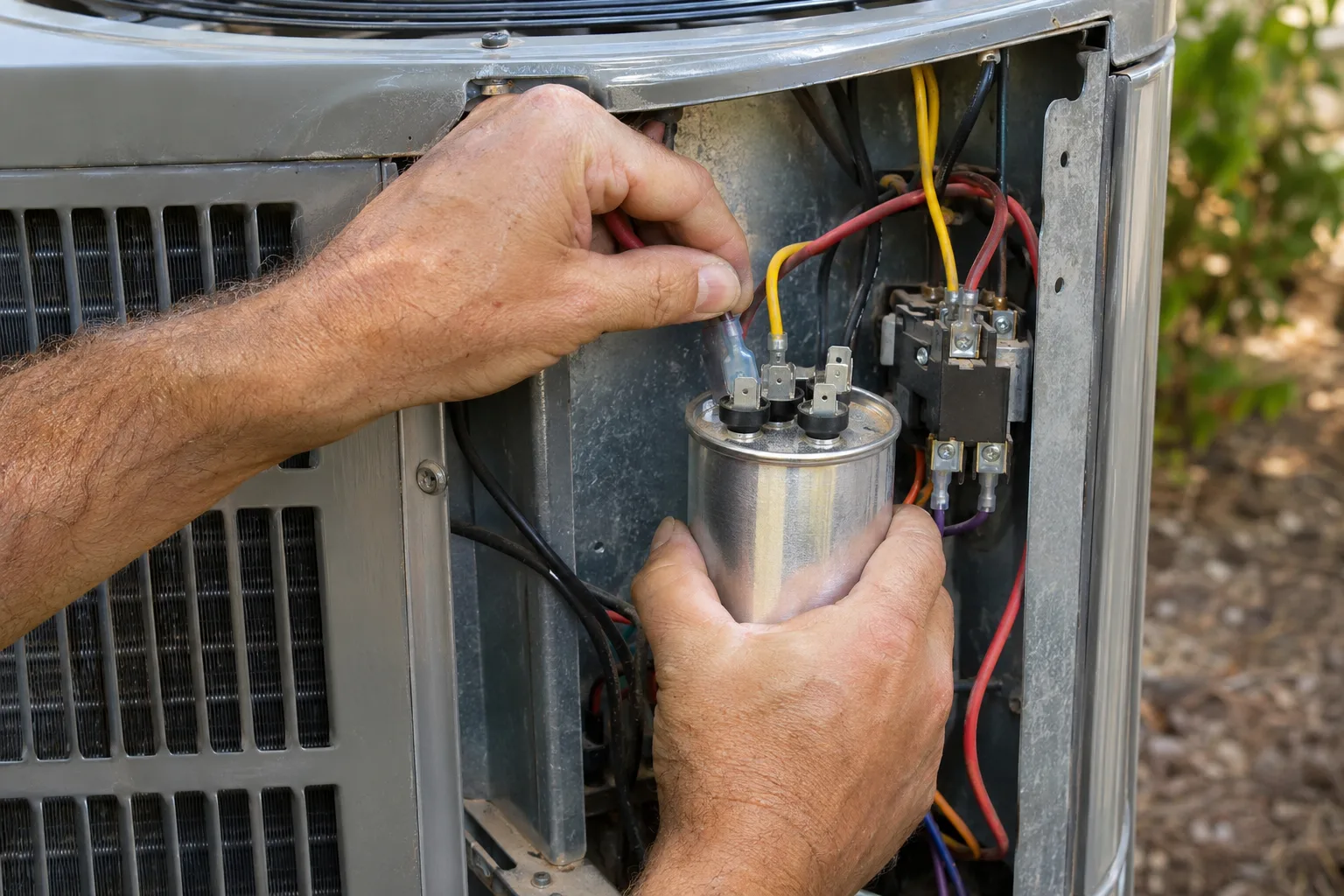
A single-phase motor cannot start on its own - it needs a phase-shifted current in a second winding to produce starting torque, and the capacitor provides that shift. In a residential condenser the run capacitor keeps both the compressor and the condenser fan motor turning efficiently. Most units use one dual-run capacitor with three terminals: common, HERM for the compressor, and FAN.
Capacitors are rated in microfarads, printed on the can, usually with a tolerance of a few percent. They fail by drifting out of tolerance, by going open, or by shorting. The visible failure mode - a bulged top or leaked oil - is unmistakable, but plenty of failed capacitors look perfectly normal and only show up on a meter.
How it should be diagnosed
A capacitor is cheap enough that some technicians replace it on suspicion. That is a defensible shortcut on a hot day, but it should still be measured, because the measurement is what tells you whether the capacitor was the problem or a victim of one.
- Measure the capacitance with a meter, after safely discharging the capacitor, and compare each section against its printed rating. A dual capacitor rated 40+5 that measures 22 and 4.6 has failed on the compressor side.
- Check the amp draw on the compressor and the condenser fan motor against the rating plate. This is the step that gets skipped, and it is the important one.
- Check line voltage, because sustained high voltage shortens capacitor life.
- Check the contactor, since pitted contacts and a failed capacitor often turn up together on the same aging unit.
Why the amp draw matters: a condenser fan motor with worn bearings or a compressor with worn windings draws more current than it should, which cooks the capacitor. Replace only the capacitor and the system runs - until the same thing happens again, often within weeks. If a technician has replaced your capacitor twice in two seasons, the motor is the real problem.
What the capacitor can hide
The part is cheap, so the real question on a capacitor call is what else the technician found. A unit presenting as a capacitor failure may also be telling you about:
- A failing condenser fan motor - a separate part and a bigger bill, but a motor replaced now is a compressor saved later, because a condenser that cannot reject heat destroys compressors.
- A hard-starting compressor on an aging system. If the compressor needs a start assist to run at all, you are looking at the end of the system's life rather than a $175 repair. See AC compressor replacement cost, where Angi puts replacement at $800 to $3,000 and Homeyou's 2026 data at an average of $2,487.
- Restricted airflow or a dirty condenser coil, which raises operating temperatures and shortens the life of everything electrical in the cabinet.
Safety: why this is not a good first DIY project
A run capacitor holds a charge after the power is off. Pulling the disconnect does not make the terminals safe - the capacitor has to be discharged deliberately through an appropriate resistance before anything touches it. Beyond the shock risk, you are working inside a cabinet with line-voltage terminals a few inches from the capacitor, and the diagnostic steps that make the repair stick - measuring motor amp draw against the rating plate - need a clamp meter and a reason to look. For a repair whose average is about $175, the professional visit is good value.
Keeping the bill at $175 instead of $2,500
Electrical components in a condenser die of heat, and most of the heat they do not need to be enduring comes from things you can control:
- Keep the filter clean. Restricted airflow raises coil temperatures and compressor load.
- Keep the condenser coil clean and clear - no shrubs tight against the unit, no cottonwood mat on the fins, nothing stacked on top of it.
- Have the condenser fan motor and compressor amp draws checked annually and recorded, so a slow rise is visible before it kills something.
- Do not run the system with the coil iced up. Turn it off, let it thaw and get it diagnosed - see AC repair cost for what else that symptom can mean.
Questions to ask
- What did the capacitor measure, and what is it rated for?
- What amp draw did the compressor and the condenser fan motor show against the rating plate?
- Is this one dual capacitor or two separate ones?
- Is the trip or diagnostic fee included in the price you quoted?
- Is there anything else in the cabinet - contactor, fan motor, coil condition - that explains why it failed?
With HVAC Service Estimator HVAC+ you can separate the trip charge, diagnostic labor and the part at local rates, which makes it clear what share of a $175 bill is the component and what share is the visit. An app estimate is informational, not a quote.
Frequently asked questions
What are the symptoms of a bad AC capacitor?
The classic one is the outdoor unit humming or clicking without starting - the compressor tries, draws locked-rotor current and trips on its internal overload. You may also see the condenser fan not spinning while the compressor runs, or the fan needing a push to start. A weak capacitor can also cause hard starting, repeated breaker trips, or cooling that quits in the afternoon heat and returns in the evening. None of these are proof on their own: the capacitor has to be measured.
Can I replace an AC capacitor myself?
This is not the DIY job it looks like online. A capacitor stores a charge after power is removed and can deliver a serious shock even with the disconnect pulled - it must be discharged safely first. The other problem is diagnostic: a capacitor is often the symptom rather than the cause. A failing compressor or a seized fan motor drawing excess current kills capacitors, and replacing the part without measuring the motor's amp draw means it fails again. Given that Fixr's average for the whole repair is about $175, the professional visit is not where the money is.
How long should an AC capacitor last?
There is no reliable published figure, so treat specific lifespan claims with suspicion. What is well understood is what shortens their life: sustained heat, high line voltage, a motor drawing more current than it should, and running the system with restricted airflow. In hot climates capacitors are a routine wear item, which is part of why this failure is so common on summer no-cool calls.
Should the technician replace both capacitors?
Many residential condensers use a single dual-run capacitor serving both the compressor and the fan motor, so there is only one part. Where separate capacitors are used, replacing a known-good one is not automatically necessary - but if one has failed on an older unit in a hot climate, having the other measured and the price quoted while the technician is already there is reasonable. Ask for the measured microfarad readings against the rated values rather than accepting a blanket recommendation.
Sources
- Fixr - Central air conditioner repair cost (2026)
- This Old House - Air conditioner repair cost
- Angi - How much does HVAC repair cost
- Thumbtack - Air conditioner repair cost
Get an estimate for your system
Snap the equipment and get an itemized estimate with equipment and labor in minutes.
More in repair costs