Heat pump cost
Updated 2026-11-07 · By the HVAC Service Estimator team
Heat pump pricing is the one number in residential HVAC where the published sources genuinely do not agree. A 2026 cost guide puts an installed heat pump at $4,200 to $7,600. Trane's own pricing guide puts it at $7,369 to $15,608. Those ranges barely overlap, and neither is wrong - they are describing different equipment and different scopes of work. This page explains the gap rather than splitting the difference, because splitting it would give you a number that matches nothing.
The two published ranges, side by side
Most cost pages pick one figure and present it with confidence. The honest version is that for heat pumps the sources conflict, and you should know both numbers before you read a quote.
| Source | Installed heat pump cost | What it appears to describe |
|---|---|---|
| 2026 cost guide | $4,200-$7,600 | Mainstream air-source equipment, straightforward changeout scope |
| Trane pricing guide (manufacturer) | $7,369-$15,608 | Trane's own lines, including higher-efficiency and variable-speed, broader scope |
| Angi 2026, gas furnace for comparison | $3,800-$10,000 | Excludes ductwork, gas line and thermostat |
| 2026 guide, central AC side for comparison | $3,900-$7,900 | Cooling only - a heat pump replaces this and the furnace |
| Angi 2026, full system average | About $7,500 | Full range $5,000-$22,000; common band $7,000-$15,000 |
Notice that Trane's heat pump range, $7,369 to $15,608, sits almost exactly on top of the $7,000 to $15,000 band where most full-system quotes land. That is a clue to what is going on: the higher figure is pricing a heat pump as a whole-house heating and cooling system replacement, because that is what it is. The lower figure of $4,200 to $7,600 prices it more like an AC changeout with a reversing valve. Which description fits your house determines which range your quotes will resemble.
What pushes a heat pump toward the high range
Equipment tier
A single-stage heat pump and a modulating, variable-speed, cold-climate heat pump are different products at different prices. The variable-speed unit holds more of its capacity at low outdoor temperatures, which reduces how much backup heat you need and how often it runs - and costs considerably more up front.
The indoor half
A heat pump needs an indoor coil and a blower. If you are keeping a working furnace and adding a heat pump outdoors as a dual-fuel system, the indoor side is relatively cheap. If you are removing the furnace entirely, you need a new air handler with heat strips, which is a whole appliance plus the sheet metal and electrical to install it.
Electrical
This is the item most homeowners do not see coming. Electric backup heat strips can draw substantially more current than the old gas furnace's blower did. The air handler often wants its own circuit or two, sized to the strip kit. On an older panel with no spare capacity, that can mean a subpanel or a service upgrade - electrical work that appears on the HVAC quote but is not HVAC work.
Ductwork and airflow
Heat pumps deliver heat at a lower supply temperature than a gas furnace - warm air, not hot air. To move the same amount of heat they need to move more air, which means the duct system matters more than it did before. A contractor who measures total external static pressure and finds it high is telling you something real. See ductwork replacement cost.
Refrigerant and the installation itself
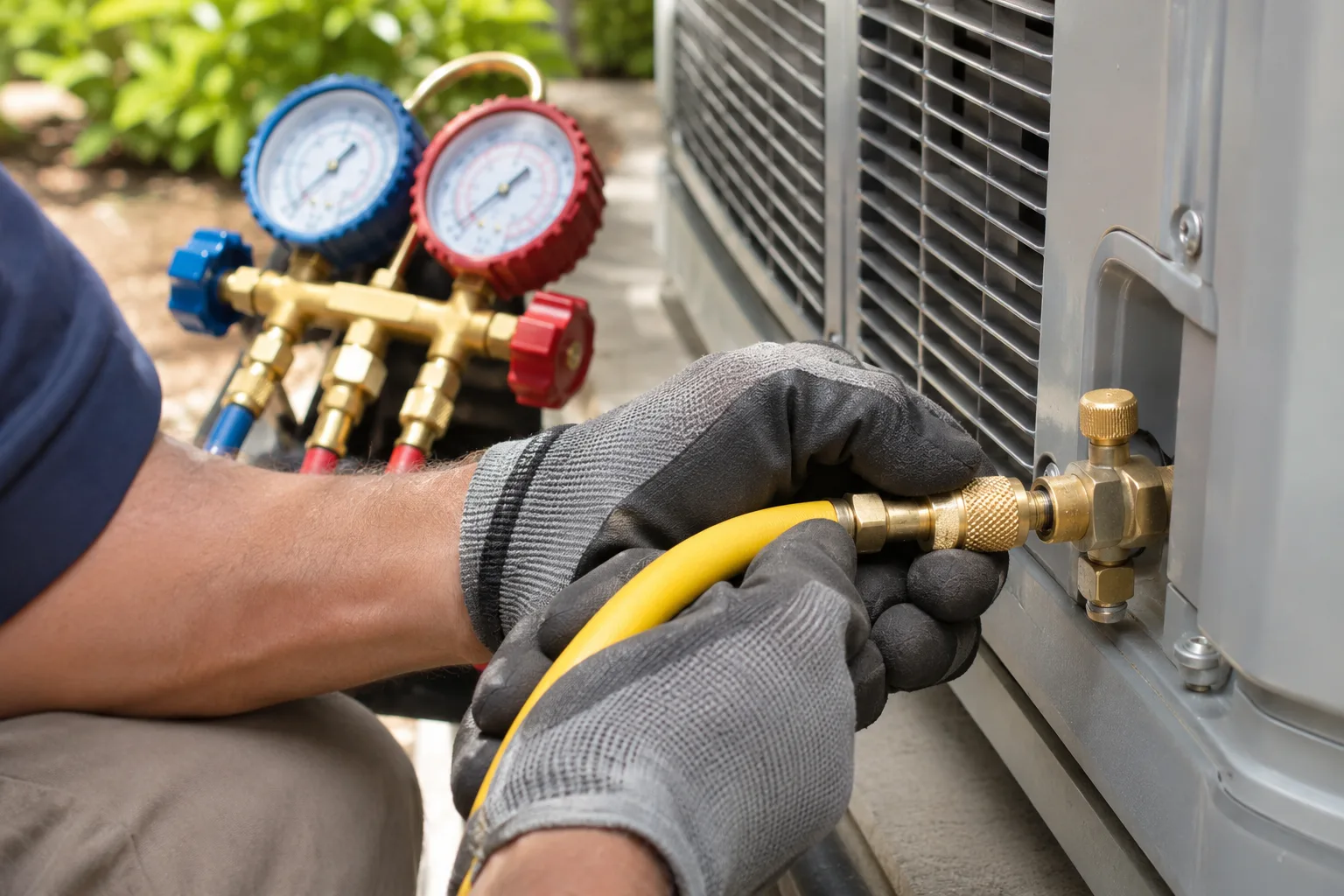
New equipment comes charged with R-454B. The install discipline is the same as any split system and it is worth asking about: recover the old refrigerant rather than venting it, braze under nitrogen, replace the filter drier, evacuate to roughly 500 microns and hold it to prove the system is dry and tight, then weigh in the charge to the nameplate rather than eyeballing gauges.
Sizing a heat pump is harder than sizing a furnace
A furnace only has to do one job. A heat pump has to cool adequately in summer and heat adequately in winter with the same box, and in most climates those two loads are not equal. Size it for the cooling load and you may lean heavily on backup heat in January. Size it for the heating load and you risk an oversized air conditioner that short-cycles and leaves the house humid.
That tradeoff is what a Manual J load calculation exists to resolve, together with a balance-point analysis that shows at what outdoor temperature the heat pump stops keeping up and the backup takes over. This is not something anyone can do from a photo of your old condenser or a square-footage rule of thumb. Ask for the load calculation and the balance point in writing, and ask how much backup heat the design assumes.
Commissioning
Ask every bidder what gets measured after startup. On a heat pump that means verifying the charge by superheat and subcooling in cooling mode, confirming blower airflow and total external static pressure, checking the temperature split, verifying the defrost cycle initiates and terminates properly, and confirming that the backup heat stages and lockouts are set correctly rather than left on factory defaults. A heat pump whose backup heat energizes too eagerly will heat your house and your electric bill at the same time. In a dual-fuel install, add a combustion analysis on the gas furnace side.
Get the startup numbers on paper. On a heat pump they matter more than on a straight AC, because there are more settings to get wrong.
Which number should you plan around?
- Keeping a good gas furnace, adding a heat pump outdoors. The lower published range is a reasonable starting expectation, since the indoor side and most of the electrical already exist.
- Replacing a whole system with a heat pump and air handler. Plan nearer Trane's $7,369 to $15,608, which lines up with the $7,000 to $15,000 band most full-system replacements land in.
- Older electrical panel, high-efficiency equipment, or duct work needed. Expect the top of that range, and get the electrical scope quoted explicitly.
Compare against AC replacement cost and furnace replacement cost if you are weighing the conventional pair instead, and see mini-split installation cost if you have no ducts at all.
Getting quotes that can be compared
Because the published ranges disagree so widely, three quotes matter more here than on almost any other HVAC job. Ask each one for: outdoor and indoor model numbers, the Manual J result and balance point, the size of the backup heat kit, whether any electrical panel work is included, whether a permit is included, and which commissioning measurements will be documented. With HVAC Service Estimator HVAC+ you can hold equipment, installation labor, electrical, duct modifications and permit as separate lines at local rates, which makes it obvious when one bidder has quietly left the electrical or the air handler out. An app estimate is informational; the number that binds is the contractor's written quote.
Frequently asked questions
Why do heat pump prices vary by more than $10,000 between sources?
Because 'heat pump' covers a huge range of equipment and scopes. A single-stage air-source heat pump matched to an existing air handler in an accessible location is a fundamentally different job from a variable-speed cold-climate heat pump with a new air handler, backup heat strips, an electrical upgrade and duct modifications. The 2026 cost guide figure of $4,200 to $7,600 describes the simpler end. Trane's $7,369 to $15,608 reflects its own equipment lines across more complete scopes. Ask any contractor which of those two jobs they are quoting.
Is a heat pump cheaper than a furnace plus AC?
Sometimes, because one piece of outdoor equipment does both jobs. Angi's 2026 figures put a gas furnace alone at $3,800 to $10,000 and the AC side at $3,900 to $7,900, with a full system averaging about $7,500 - so a heat pump at the lower published range can undercut that, while one at Trane's upper range does not. The operating-cost comparison depends on your local electricity and gas prices, which no national guide can tell you.
Do I still need backup heat with a heat pump?
In most of the country, yes, in some form. A heat pump's capacity falls as the outdoor temperature drops, and below the balance point it cannot keep up alone. The backup is usually electric resistance heat strips in the air handler, or an existing gas furnace in a dual-fuel setup. Heat strips draw serious current, which is why a heat pump install sometimes turns into an electrical service question - and that electrical work is one reason quotes diverge so much.
What refrigerant do new heat pumps use?
New residential equipment now ships on R-454B rather than R-410A. That matters if you are replacing only part of an existing R-410A system: a new R-454B outdoor unit cannot be matched to an R-410A indoor coil. If your existing system is R-22, repair is impractical and you are in replacement territory regardless.
Sources
Get an estimate for your system
Snap the equipment and get an itemized estimate with equipment and labor in minutes.
More in repair costs