HVAC service call rates and diagnostic fees
Updated 2026-11-07 · By the HVAC Service Estimator team
The service call fee is the first number a customer hears from you and the one most contractors price by copying a competitor. It should instead cover what it actually consumes: drive time, diagnostic time, the instruments on the truck, and the share of overhead that a short visit has to carry. Work it out from your own costs, then decide deliberately whether it gets credited against the repair.
The calculator below works out what a service call has to cost you to break even, and what it has to be priced at to hit your target margin. Enter drive time, diagnostic time, your loaded hourly cost and overhead per visit, then compare the result with what you currently charge.
What a service call actually consumes
A thirty-minute diagnosis is never a thirty-minute cost. The visit consumes:
- Drive time, both directions, which in a spread-out service area can exceed the time on site.
- Vehicle cost: fuel, payment, insurance, tires and maintenance for those miles.
- Diagnostic time, which is skilled work with gauges, a meter, a clamp ammeter, a micron gauge and often a combustion analyzer.
- Instrument cost and calibration, amortized across visits.
- Scheduling and dispatch: the call that booked it, the confirmation, the follow-up.
- Overhead per visit: insurance, licensing, software, the building, your own time.
- The visits that produce nothing billable: a customer who cancels at the door, a problem that turns out to be a tripped breaker, a quote that does not convert.
Price only the time on site and the other items come out of your margin on every call.
Working out your own figure
- Measure the real visit length. Not the appointment slot - door to door, including drive time both ways. Track it for two weeks.
- Apply your loaded hourly cost. Wage plus payroll taxes, workers' compensation and benefits. The HVAC labor rates guide covers building this figure.
- Add overhead per visit. Monthly overhead divided by the number of visits you actually complete in a month.
- Add vehicle cost for the miles.
- Apply your target margin. Divide the total by one minus the margin.
Worked example
Illustrative inputs only - substitute your own. A visit averages 45 minutes on site and 40 minutes of round-trip driving, so 1.4 hours door to door. At a loaded cost of $55 an hour that is $77. Add $45 of overhead per visit and $18 of vehicle cost, giving $140 at cost. At a 20 percent target margin, $140 divided by 0.80 is $175. If your current service call fee is well under that, the gap is coming out of the repair margin or out of your own pay.
Credit it or keep it
Three defensible policies. Pick one, publish it, and apply it consistently.
| Policy | How it works | Trade-off |
|---|---|---|
| Fee stands | Diagnostic fee is charged whether or not work proceeds | Protects your time; looks dearer to a price shopper |
| Credited to repair | Fee is waived or deducted if the repair is authorized | Converts more repairs; a declined job pays below cost |
| Credited to replacement only | Fee stands on repairs, credited against a changeout | Rewards the large sale; needs clear explanation on the phone |
Whichever you choose, say it when the call is booked, not when you arrive. A customer told the number in advance almost never argues about it; a customer surprised by it at the door argues about it every time. And whichever you choose, put the fee on the estimate and the invoice as a labor line - if you credit it, show the fee and show the credit as two separate lines rather than quietly dropping it. See the invoice template for the layout.
Diagnostic visits and sales calls are different things
Keep the distinction sharp when the call is booked, because it decides whether the visit is free:
- A diagnostic visit answers "why is it not working." That is skilled, instrumented troubleshooting and it is billable.
- A replacement quote answers "what would a new system cost." That is a sales call, and treating it as a marketing expense is reasonable.
- A maintenance visit is scheduled, priced work under an agreement or as a one-off.
The calls that go wrong are the ones booked as one and performed as the other - a homeowner who asked for a quote and actually wants a diagnosis. Clarify on the phone and the invoice writes itself.
Where the fee sits inside the finished bill
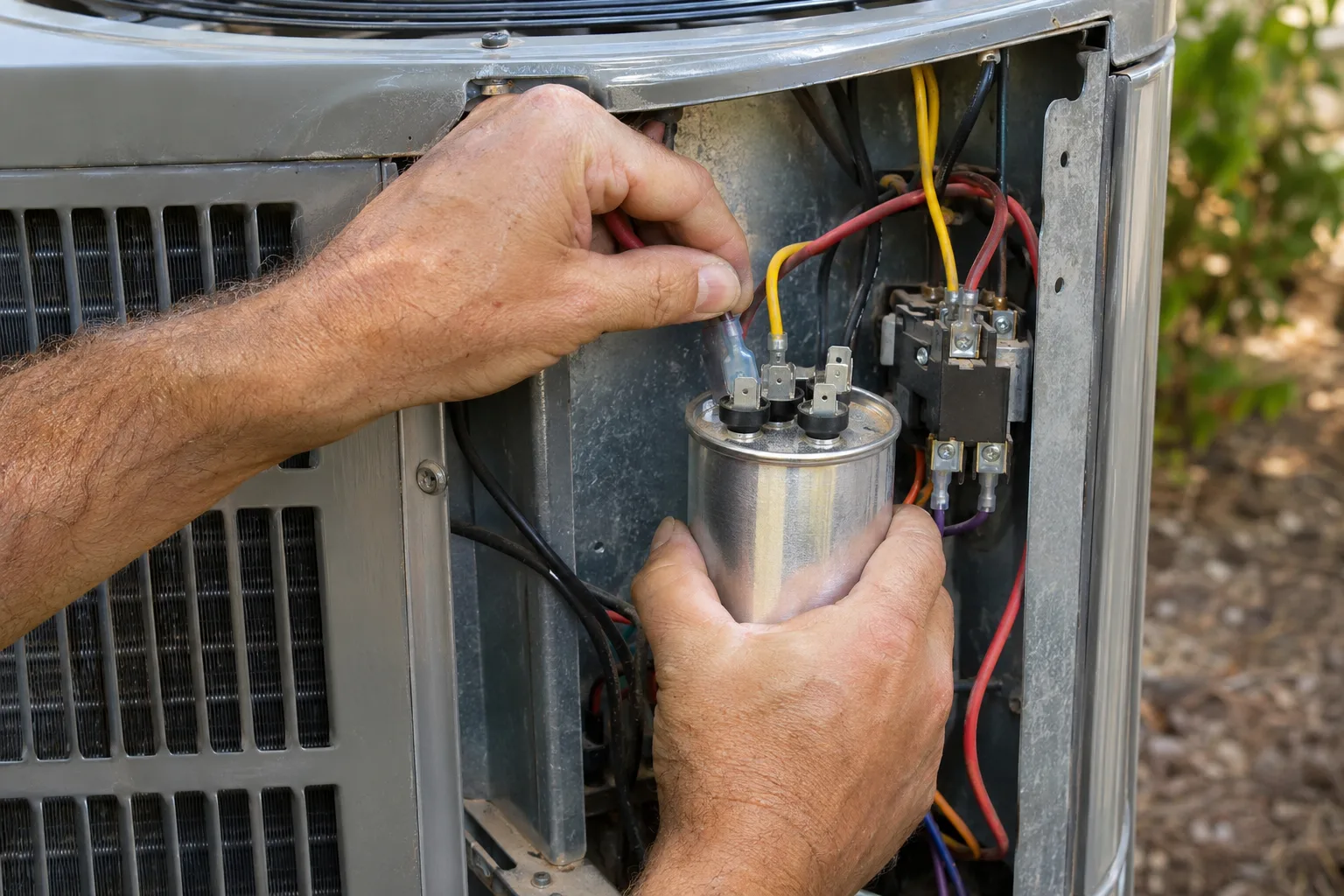
The service call fee is usually a modest share of what a repair invoice totals, which is worth remembering when a shopper focuses on it. Fixr puts overall central AC repair at $375 on average with most jobs between $250 and $700. Inside that, Fixr shows capacitor work at $100 to $400 with an average near $175, and This Old House shows $150 to $400 parts and labor for the same job.
Sealed-system work totals considerably higher because more labor happens: recover the charge with an EPA 608 certified technician, braze and pressure-test with dry nitrogen, evacuate to 500 microns, then weigh in the charge. Fixr puts refrigerant leak repair at $200 to $1,600 with an average near $800, Angi shows $250 to $1,500 for repair against $100 to $500 for a recharge alone, and Homeyou reports an average of $837 within a $479 to $1,389 band. Compressor work runs higher still - Angi shows $800 to $3,000 and Homeyou reports $1,679 to $3,687 with an average of $2,487.
That last figure is where a diagnostic visit often turns into a replacement conversation, particularly on an R-22 system, where a like-for-like sealed-system repair is no longer practical because the refrigerant is out of production and remaining supply is both expensive and inconsistent. The diagnostic fee is what paid for finding that out, and it is the reason the customer can now make an informed decision instead of a guess.
Separate rates worth publishing
- Normal hours diagnostic, your base figure.
- After hours, weekend and holiday, as a distinct published rate rather than a vague surcharge.
- Second system at the same address, at a reduced figure since the drive is already paid for.
- Maintenance agreement holders, at a reduced or waived fee as part of what the agreement buys.
- Extended diagnosis, hourly beyond the first hour for intermittent faults, airflow problems and control issues that genuinely take longer.
That last one matters. Intermittent faults are the jobs that destroy a flat diagnostic fee, because the honest answer sometimes takes three hours. Say up front that diagnosis beyond the first hour bills hourly, with a not-to-exceed figure, and you can afford to chase the problem properly instead of guessing to get out of the house.
Next: build the hourly numbers in the HVAC labor rates guide, and turn the diagnosis into a document with the HVAC estimate template.
Frequently asked questions
What is a typical HVAC service call fee?
This page does not publish one. We have no source we are willing to cite for a current, methodologically sound national service call fee, and the figures circulating online are mostly undated or derived from consumer quote estimates. Calculate yours from drive time, diagnostic time and overhead using the method below.
Should the diagnostic fee be credited toward the repair?
Either approach works as long as you decide it in advance and say it on the phone. Crediting it converts more repairs but means a declined job pays you less than the visit cost. Keeping it protects your time but makes you look more expensive to a price shopper. What loses money is deciding at the door.
Can I just give a free estimate instead?
On a replacement quote, often yes - you are selling, and a sales call is a marketing cost. On a diagnostic visit, no. Finding out why a system is not cooling is skilled work with instruments, and giving it away means your paying customers subsidize the shoppers. Keep the distinction clear when you book the call.
How should after-hours calls be priced?
As a separate rate, not a vague surcharge. Nights, weekends and holidays cost you premium wages and real disruption, and a customer calling at 9pm in August knows it. Publish the after-hours figure so there is no argument on arrival, and keep it distinct from your normal service call fee.
Sources
- Fixr - Central air conditioner repair cost 2026
- This Old House - Air conditioner repair cost
- Thumbtack - Central air conditioner repair cost
Estimates and invoices in minutes
HVAC Service Estimator turns a photo into an itemized estimate, then an invoice. Free to download.
More in for shops