Free HVAC invoice template
Updated 2026-11-07 · By the HVAC Service Estimator team
An HVAC invoice has to do two jobs: get you paid now, and still make sense in three years when a warranty claim is filed or the house is sold. That means model and serial numbers for everything installed, labor hours shown, refrigerant by the pound, the permit number, and the commissioning readings you actually measured. The generator below produces that document.
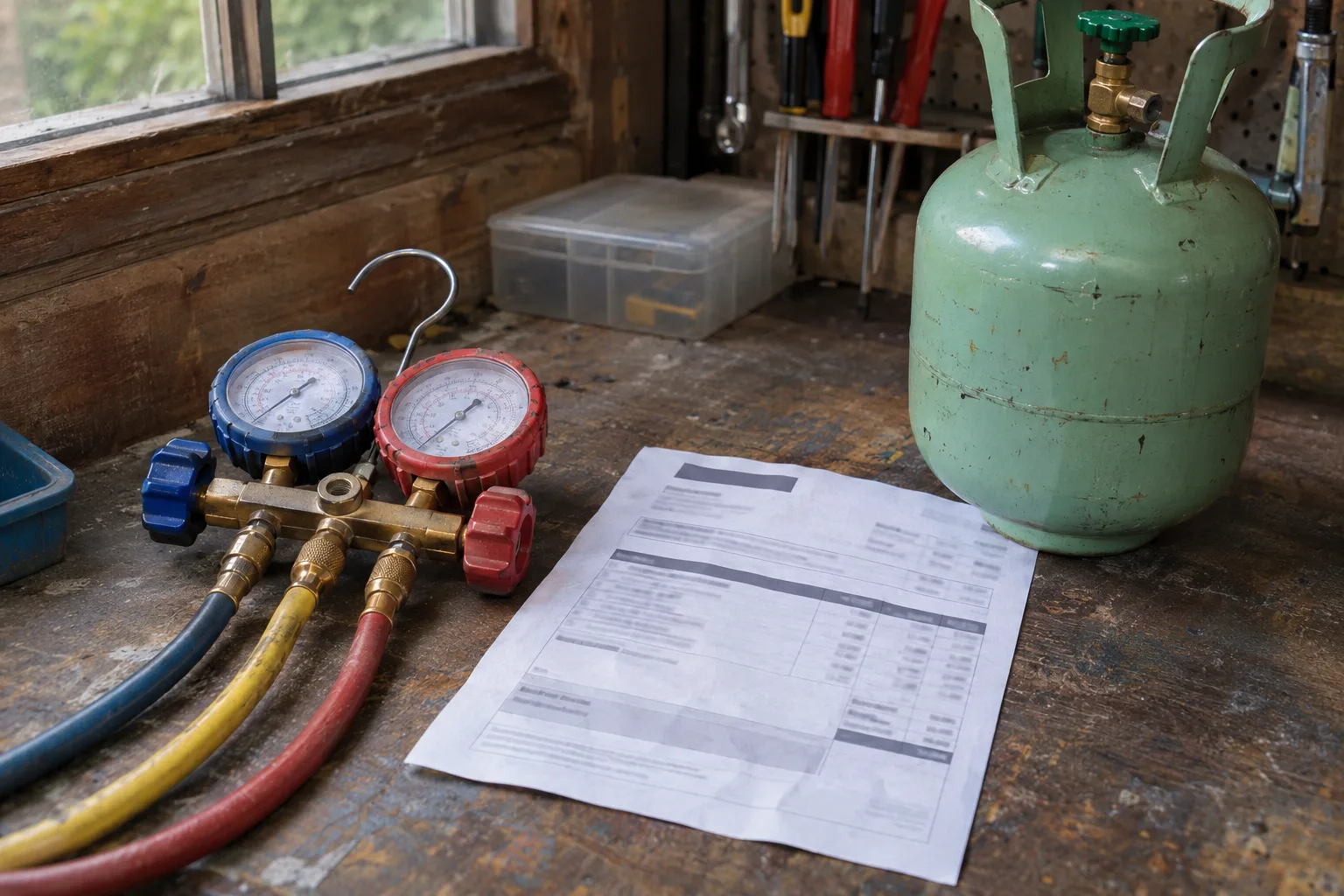
Enter the customer, the equipment you installed and the labor you performed, add the commissioning readings and the permit number, and download a printable PDF. The template handles a single-part repair and a full changeout with the same structure.
What belongs on an HVAC invoice
- Your details: company name, address, phone, contractor license number, invoice number and date.
- Customer and service address, with the billing address separately where they differ.
- Equipment installed: each unit with capacity, efficiency, model number and serial number.
- Labor: hours and rate, by work type rather than as one lump.
- Refrigerant: by the pound, with the type named - R-410A or R-454B.
- Sealed-system work performed, itemized by step.
- Commissioning readings, the actual measured values.
- Permit fee and permit number, with inspection status if it is still pending.
- Access charges where the attic, crawlspace, roof or a crane made the job longer.
- Tax, total and payment terms, plus warranty terms.
Model and serial numbers are the point
This is the part that gets skipped and the part that matters most after the check clears. Model and serial numbers are what a manufacturer warranty registration is filed against, what a warranty claim is validated against, what the next technician needs to order a part, and what a home inspector or buyer's agent will ask for at resale. Photograph the data plate on each unit and transcribe from the photo, not from memory in the truck.
| Invoice line | Category | Also record |
|---|---|---|
| 3-ton condenser, 14.3 SEER2, R-454B | Material | Model and serial |
| Matched 3-ton evaporator coil, cased | Material | Model and serial |
| 80,000 BTU gas furnace, 80% AFUE | Material | Model and serial |
| Changeout labor, two techs | Labor | Hours and rate |
| Attic access and equipment handling | Labor | Hours |
| R-454B, weighed in | Material | Pounds, actual |
| Recover, braze, nitrogen test, evacuate to 500 microns | Labor | Hours, EPA 608 tech |
| Commissioning and documented readings | Labor | The readings themselves |
| Mechanical permit and inspection | Pass-through | Permit number, inspection result |
Equipment and labor stay on separate lines
The same rule as on the estimate, for the same reason, plus one more: the invoice is the document that outlives the sale. A bill reading "HVAC system installed - $9,800" tells a future reader nothing, and tells the customer nothing they can reconcile against the quote they approved. A bill naming a 3-ton 14.3 SEER2 condenser with a serial number, a matched coil, 4 pounds of R-454B weighed in, labor hours, a permit number and a measured subcool value tells them everything and ends the conversation.
Commissioning readings on the bill
Leave space on the invoice for the numbers, and fill them in:
- Superheat and subcool, measured.
- Supply and return static pressure.
- Measured airflow against the design value.
- Combustion analysis results on gas equipment.
- Thermostat configuration and staging verified.
This takes a minute and it is the cheapest insurance on the document. When a homeowner calls next August convinced the system has never cooled properly, an invoice with measured subcool and static pressure from install day tells you whether to look for a new problem or to explain an old one. Without it you are starting from zero on your own dime.
Repairs: carry the service call fee through
Most repair invoices start with a diagnostic visit, so the service call fee goes on the bill as its own labor line. If you credit it against the repair, show both the fee and the credit. Published repair bands give a sense of where finished invoices land: Fixr puts central AC repair at $375 on average with most jobs between $250 and $700, capacitors at $100 to $400 with an average near $175, and This Old House shows $150 to $400 parts and labor for capacitor work.
On sealed-system repairs, itemize what was done and name which product the customer bought. The published gap makes the distinction worth printing: Angi shows leak repair at $250 to $1,500 against a recharge alone at $100 to $500. If the customer declined the leak search and bought a recharge, the invoice should say so in writing, because that is the call you will be asked about when the charge is low again.
Changes and approvals
Work added after the estimate was signed goes on the invoice as its own dated line with the approval recorded: who, when, how and for how much. On a changeout this is routine - a transition that had to be rebuilt, a disconnect that was not to code, a condensate line with no trap. Documented, none of those are disputes. Undocumented, all of them are. And if a line on the estimate turned out not to be needed, remove it and let the invoice come in under the estimate; a customer who sees that once trusts every line you write afterward.
Payment and warranty terms
- When payment is due and what happens after that date.
- What the labor warranty covers and for how long, stated separately from the manufacturer's equipment warranty.
- Whether you filed the equipment warranty registration, and the serial numbers it was filed against.
- Inspection status if the jurisdiction's inspection has not yet happened.
- What voids the labor warranty - filter neglect being the one worth naming explicitly.
- Accepted payment methods.
Invoice from the property, not from the kitchen table
The practical argument for finishing the invoice on site is that the information is all in front of you: the data plates are readable, the gauges are still on, the readings are current rather than remembered. Finish it in the driveway and the customer signs while the equipment is running, which is also the easiest moment to get paid.
See HVAC invoice software for carrying an approved estimate through without retyping, start with the HVAC estimate template, and use the HVAC work order template for the step between them.
Frequently asked questions
What has to be on an HVAC invoice?
Company name, license number and contact details; the customer and service address; invoice number and date; equipment installed with model, serial and capacity; labor hours and rate; refrigerant by type and weight; permit fee and permit number; commissioning readings; tax; the total; and payment terms. Model and serial numbers are the part people skip and the part a warranty claim depends on.
Should the invoice match the estimate?
Line for line, then add what was measured and what was actually used. Changes get their own dated lines with the approval recorded - who approved it, when and for how much. An invoice that reorganizes the estimate into different categories invites the customer to go hunting for what moved.
Why put commissioning readings on the invoice?
Because they are the evidence the system was set up rather than merely installed. Superheat and subcool, static pressure, measured airflow and combustion analysis on gas equipment, recorded on the bill, settle a performance complaint next summer without a return trip and an argument about what was done.
Do I invoice the diagnostic fee separately?
Yes, as its own labor line. If you credit it against the repair, show the fee and show the credit as two lines rather than quietly dropping it. The customer agreed to that fee before you arrived and should see it honored on the document either way.
Sources
- Fixr - Central air conditioner repair cost 2026
- This Old House - Air conditioner repair cost
- Angi - Freon leak repair cost
Invoice from the estimate you already wrote
An approved estimate becomes an invoice in one tap, with the commissioning readings and serial numbers attached.
More in for shops