The owner-operator HVAC app
Updated 2026-11-07 · By the HVAC Service Estimator team
Running one truck means you are the technician, the estimator, the dispatcher and the bookkeeper. The paperwork does not get easier because there is less of it - it gets harder, because it all lands on you after a ten-hour day. The point of estimating from a phone is that the document gets finished in the driveway instead of at the kitchen table at nine at night.
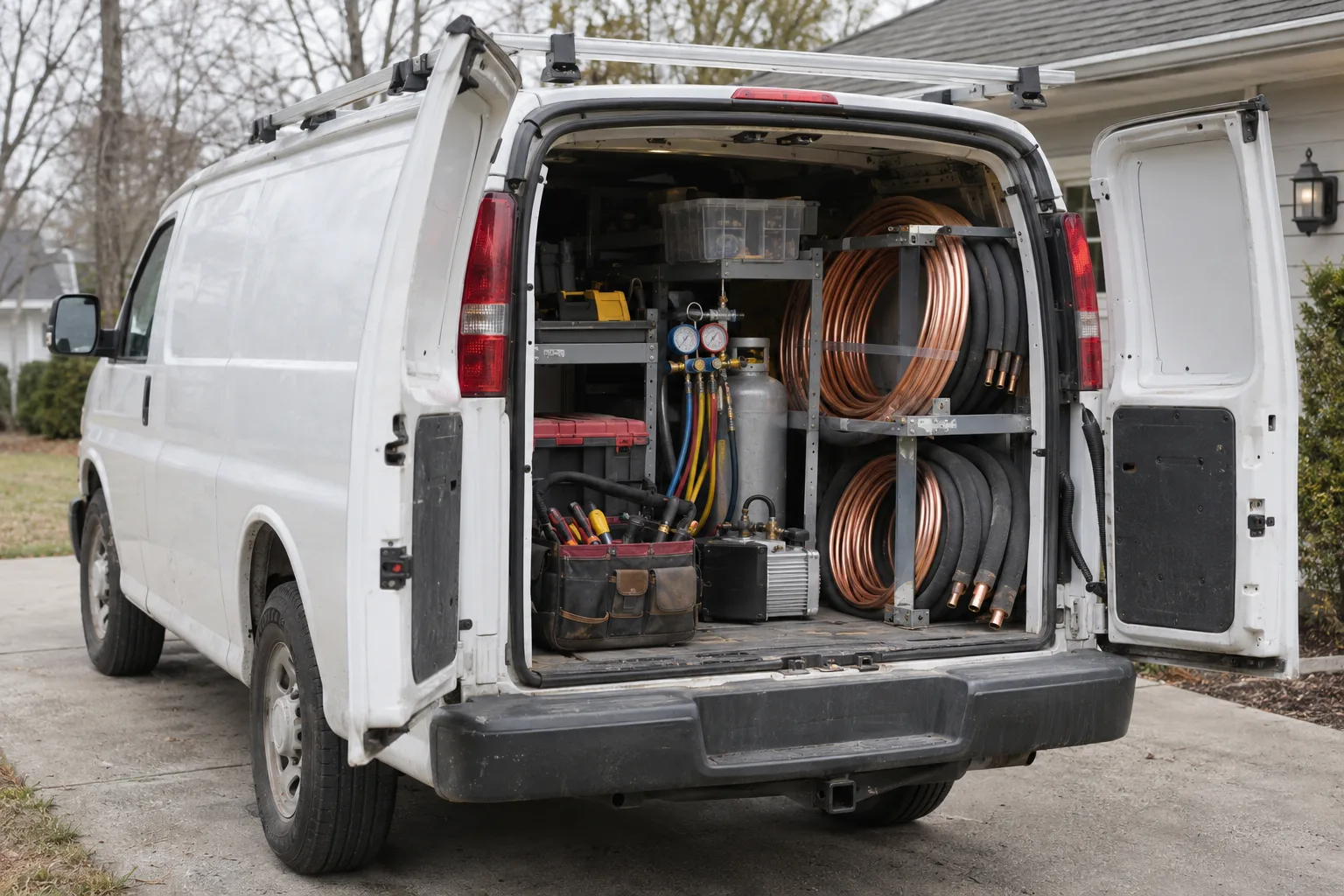
The real constraint is after-hours time
With one truck, every quote you write is time you are not billing, and every quote you write in the evening is time you are not resting. The usual result is one of two bad habits: you give verbal numbers you later have to defend, or you let quotes pile up and lose jobs to whoever answered faster.
Finishing the document on site fixes both. You photograph the equipment, dictate what you found, review the itemized estimate, and hand the customer a link before you pull out of the driveway. They have a real document while they still remember the conversation, and your evening stays yours.
What goes on a one-truck estimate
The structure is the same as a larger company's, because the work is the same and the customer is comparing you to them. Nothing bundled:
- Service call or diagnostic fee as a labor line when the visit started as a service call.
- Equipment as material, with capacity in the description: "3-ton condenser, 14.3 SEER2," not "new AC."
- Installation labor in hours at your rate, separately.
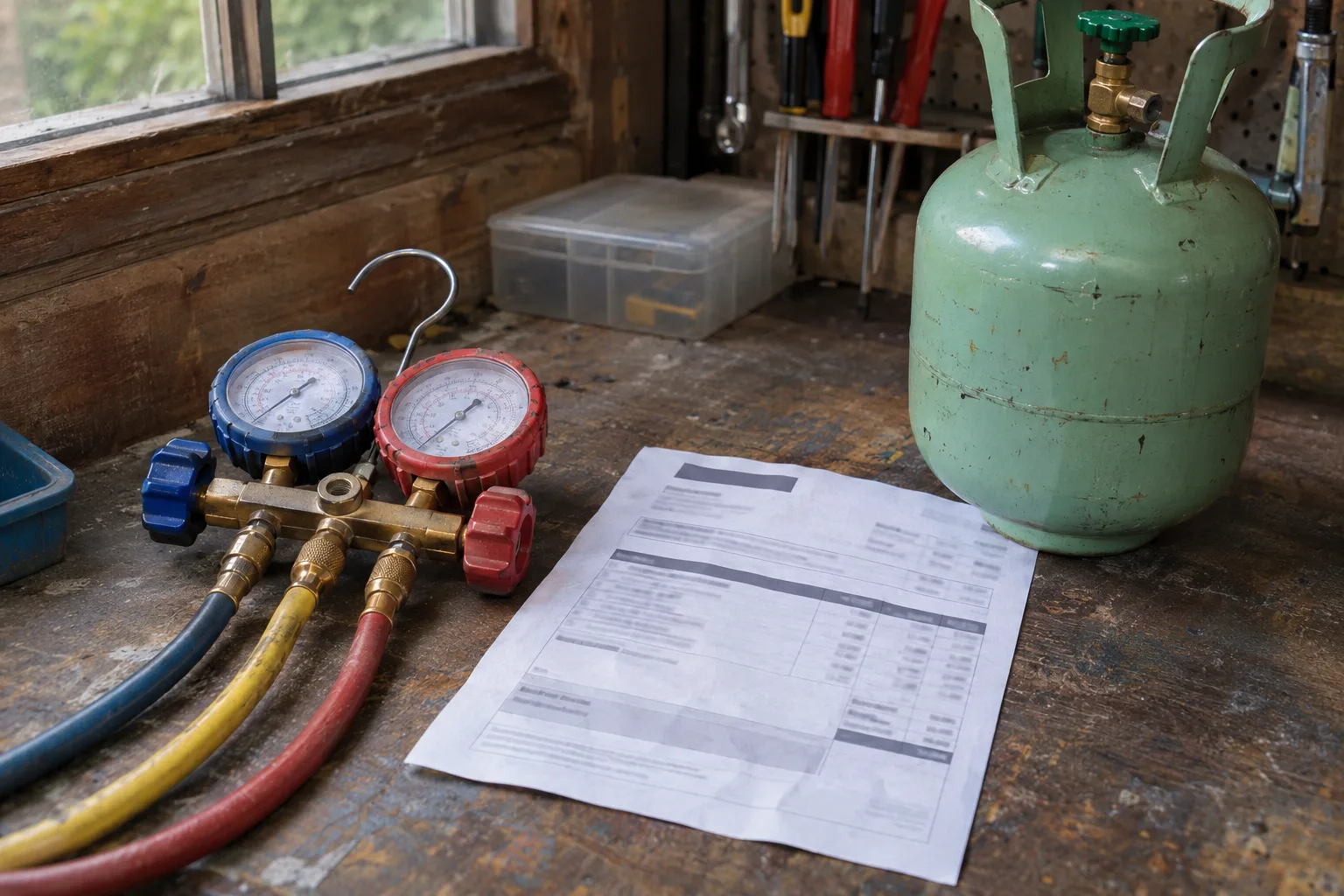
- Refrigerant by the pound, type named: R-410A or R-454B.
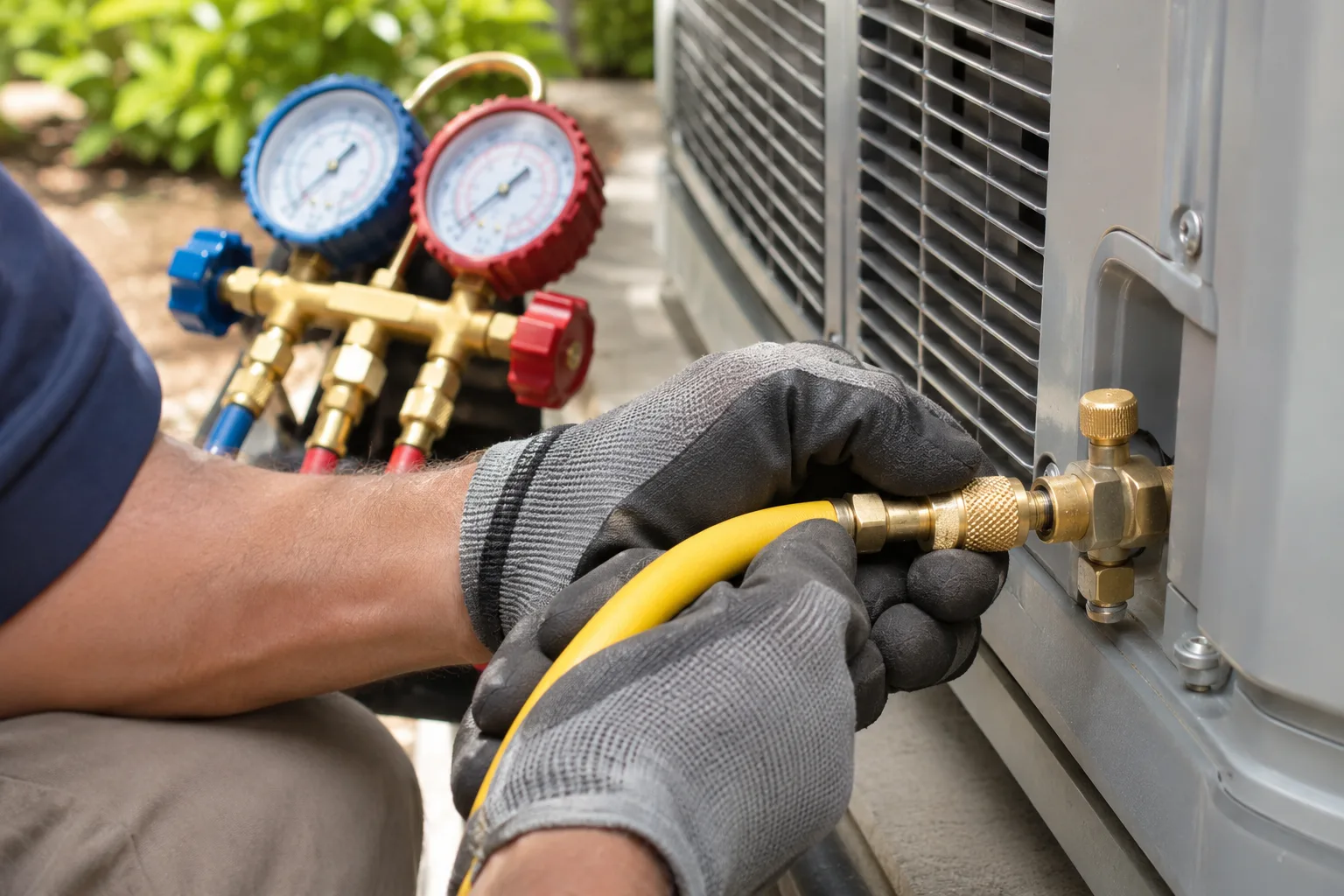
- Sealed system labor broken out: recover, braze and nitrogen pressure test, evacuate to 500 microns, weigh in the charge.
- Commissioning as its own line - superheat and subcool, static pressure, airflow, and combustion analysis on gas equipment.
- Permit and inspection as a pass-through, plus your labor to pull it and meet the inspector.
- Access: attic, crawlspace, roof or crane, priced as the labor it is.
That last one matters more to a one-man operation than to a crew. A crawlspace changeout you handle alone takes materially longer than it takes two technicians, and if access is not a line on the estimate, that time comes out of your own margin every single time.
Itemizing is your competitive advantage
You will rarely win on price against a company with buying volume. You can routinely win on clarity. Published replacement figures show how little a single number tells a homeowner: Angi puts a full system at about $7,500 on average over a $5,000 to $22,000 range, aggregated 2026 guides put the common band at $7,000 to $15,000, 2026 guide data shows central AC alone at $3,900 to $7,900 installed, and Angi shows gas furnace replacement at $3,800 to $10,000 before ductwork, gas line work or a thermostat.
Against ranges that wide, a bundled competing quote is unverifiable. Your itemized estimate, where the homeowner can see the permit you included, the lineset you are replacing and the commissioning you will document, gives them a reason to pick you that is not a discount.
Repair pricing on one truck
Service and repair is where an owner-operator usually makes a living, and the published bands are useful as a sanity check on your own pricing rather than as prices to adopt.
| Job | Published range | Source |
|---|---|---|
| AC repair, overall | $375 average; most $250-$700 | Fixr 2026 |
| Capacitor | $100-$400, average about $175 | Fixr 2026 |
| Capacitor, parts and labor | $150-$400 | This Old House 2026 |
| Refrigerant leak repair | $200-$1,600, average about $800 | Fixr 2026 |
| Refrigerant leak repair | $250-$1,500; recharge alone $100-$500 | Angi 2025 |
| Refrigerant leak repair | $837 average ($479-$1,389) | Homeyou 2026 |
| Compressor | $800-$3,000 | Angi 2025 |
| Compressor changeout | $1,679-$3,687, average $2,487 | Homeyou 2026 |
Note the gap between leak repair and recharge in Angi's figures. Selling a recharge without finding the leak is selling the customer a problem that comes back, and on one truck a comeback costs you a billable slot you cannot replace. Price the leak search and the sealed-system sequence properly or decline the job.
The R-22 conversation you will have constantly
Older systems are the owner-operator's daily bread and the place where honesty pays. On an R-22 machine, like-for-like sealed-system repair is no longer practical: the refrigerant is out of production, remaining supply is expensive and inconsistent, and the system is old regardless. Put the repair estimate and the replacement estimate side by side, both itemized, and let the compressor figures above carry the argument. A customer who was told the truth about a twenty-year-old system calls you for the replacement, and calls you again for the next house.
Sizing: do not sell a tonnage off a photo
The temptation on one truck is to quote the capacity that is already installed and move on. Resist it. The existing size may be a previous contractor's error, or correct for a house that has since had windows, insulation or an addition. Capacity gets confirmed with a Manual J load calculation. Write the estimate around the equipment and labor, state on the document that final capacity is subject to the load calculation, and do the calculation before you order. Getting this wrong on one truck means you personally go back and do it again.
Keeping the back office small
- One document chain. Estimate becomes work order becomes invoice, with no retyping, so the three always match.
- Photos attached to the job. The data plate, the model and serial, the before and after. This is your warranty record and your defense.
- History by address. Next summer's call opens with what you did last time instead of a guess.
- Paid or unpaid, visible. With one truck, chasing money is time off the tools.
Set your hourly numbers with the HVAC labor rates guide, price the visit itself with HVAC service call rates, and follow how to write an HVAC estimate for the full sequence.
Frequently asked questions
What do I actually need to run estimates and invoices on one truck?
A way to produce an itemized estimate on site, get it approved, and turn it into an invoice without typing it twice. Everything else is optional until you have a second truck. What you do not need is a platform priced for a dispatch board you do not have.
How do I compete with a big company's price?
Usually not by being cheapest - by being clearer and faster. A homeowner comparing your itemized estimate against a competitor's single bundled number can see what they are buying from you. Published replacement ranges are wide enough that the only honest comparison is line by line.
Should I charge a diagnostic fee as a one-man operation?
Yes. Your drive time and diagnostic time are the scarcest things you own, and giving them away means the free quotes subsidize the paying work. Say the fee on the phone before you book, put it on the estimate as a labor line, and decide deliberately whether you credit it against the repair.
Can I skip the permit on a small changeout to stay competitive?
No. Permits and inspections are real costs on changeouts and skipping them puts the liability on you, not the customer, including on resale when the work shows up as unpermitted. Price it as a pass-through line and let the customer see that the cheaper quote left it out.
Sources
- Fixr - Central air conditioner repair cost 2026
- Angi - HVAC replacement cost 2026
- This Old House - Air conditioner repair cost
Estimates and invoices in minutes
HVAC Service Estimator turns a photo into an itemized estimate, then an invoice. Free to download.
More in for shops