How to write an HVAC estimate
Updated 2026-11-07 · By the HVAC Service Estimator team
A good HVAC estimate is specific enough that a technician could do the job from it and a homeowner can tell what each line buys. The structure matters more than the prices: equipment is a material line, installation is labor, refrigerant is priced by the pound, and commissioning and permits are their own lines. Here is the sequence, with the steps that get skipped most often.
Step 1: Record the customer, the equipment and the complaint
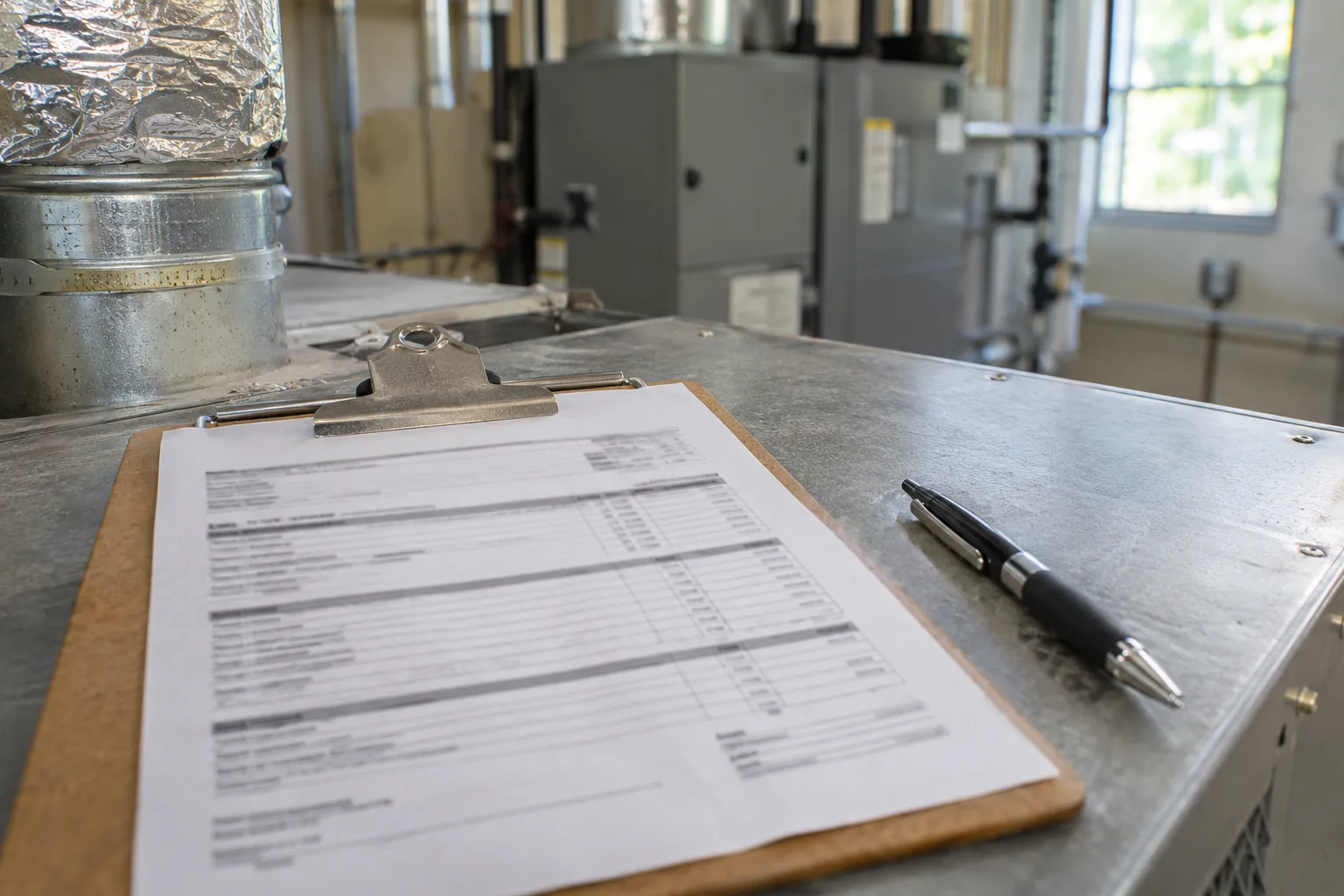
Customer name, phone, email and the service address, which on rental and property management work is not the billing address. Then the equipment, read off the nameplate rather than from memory: make, model, serial, capacity in tons or BTU, efficiency rating, refrigerant type and electrical data. Photograph the plate. Model and serial decide parts availability, warranty status and whether you are looking at an R-22 machine.
Record the complaint in the customer's words - not cooling, short cycling, water on the floor, a smell when the heat comes on - and keep your own findings in a separate field. That separation matters when the customer later remembers the conversation differently than the document.
Step 2: Inspect the whole system, not the complaint
A no-cool call is rarely only about the condenser. Check the indoor coil and blower, filter, condensate drain and trap, lineset and insulation, disconnect and wiring, thermostat, and ductwork where visible. On gas equipment check the heat exchanger, venting and combustion air. Note existing problems you are not asked to fix - a sagging duct, a condensate line with no trap, an undersized return - because they explain performance new equipment will not fix by itself.
Step 3: Decide repair or replace, and be able to show it
This is the judgment the customer is really paying for, and the published ranges make the arithmetic visible. Fixr puts overall AC repair at $375 on average, most jobs $250 to $700, and capacitors at $100 to $400. Compressor work runs $800 to $3,000 per Angi and $1,679 to $3,687 with an average of $2,487 per Homeyou. Against a full system at about $7,500 on average per Angi, a compressor at the top of that band on an old machine is a hard sell.
- R-22 systems: like-for-like sealed-system repair is no longer practical. The refrigerant is out of production and remaining supply is expensive and inconsistent.
- Write both, itemized. A repair quote beside a replacement quote lets the customer decide. A verbal recommendation with one number does not.
Step 4: Confirm capacity with a load calculation
Never sell a size off a photo or off the nameplate of what is already there. The existing equipment may be a previous contractor's mistake, or correct for a house that has since gained insulation, new windows or an addition. A Manual J load calculation accounts for square footage by zone, construction and insulation values, window area and orientation, infiltration, and duct losses.
Build the estimate around the equipment and labor so the customer has a document the same day, and state that final capacity is subject to the load calculation. Do it before ordering. An oversized system short cycles, dehumidifies poorly and dies early, and the customer will blame the installer, correctly.
Step 5: List equipment as material, with capacity in the description
Each unit on its own line with capacity and efficiency written in. "3-ton condenser, 14.3 SEER2, R-454B" can be taken to another contractor and compared. "Outdoor unit" cannot.
| Write | Not |
|---|---|
| 3-ton condenser, 14.3 SEER2, R-454B | New AC unit |
| Matched 3-ton evaporator coil, cased | Indoor coil |
| 80,000 BTU gas furnace, 80% AFUE, single-stage | Furnace |
| 2.5-ton heat pump with 10 kW backup heat kit | Heat pump system |
| 3/4 in x 3/8 in lineset, 30 ft, insulated | Misc materials |
For reference, Trane's pricing guide lists an 80% single-stage gas furnace at $5,093 to $5,481, and Angi shows gas furnace replacement at $3,800 to $10,000 before ductwork, gas line work or a thermostat. Heat pump sources disagree sharply - a 2026 guide shows $4,200 to $7,600 against Trane's $7,369 to $15,608 - a reason to quote supplier cost, not a published figure.
Step 6: List installation labor separately, in hours
Installation is labor and belongs on its own line at your rate, with the hours shown - even when you have a flat changeout price in mind, because the moment scope changes you must show which part of the number moved. The HVAC labor rates guide covers building the rate.
Step 7: Break out the sealed system sequence
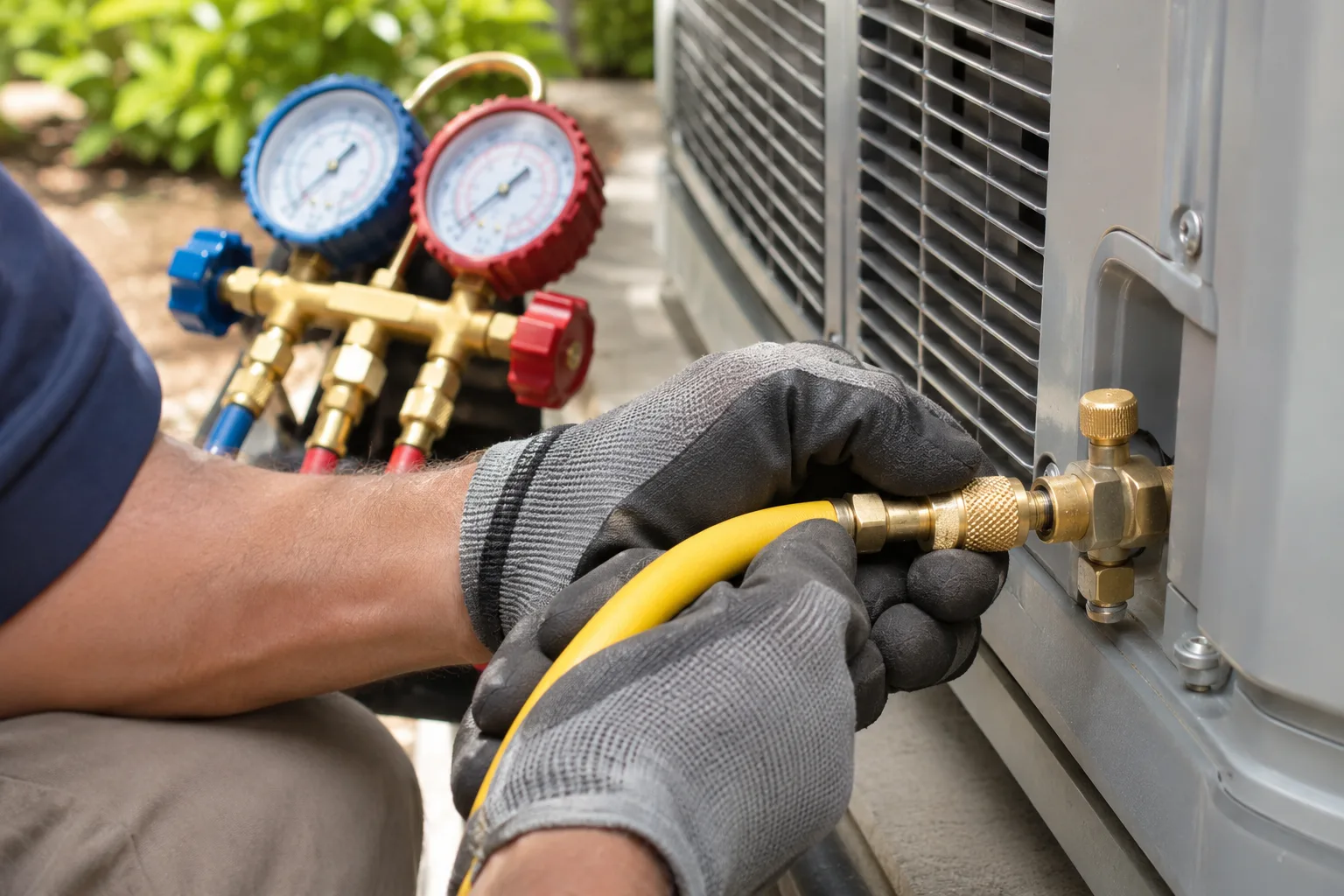
Any job that opens the refrigerant circuit follows the same order, and each step is labor:
- Recover the existing charge with recovery equipment, by an EPA 608 certified technician.
- Braze the joints, pressure-testing with dry nitrogen to confirm they hold.
- Evacuate to 500 microns and confirm the vacuum holds with the pump isolated.
- Weigh in the charge to the nameplate value, adjusted for lineset length.
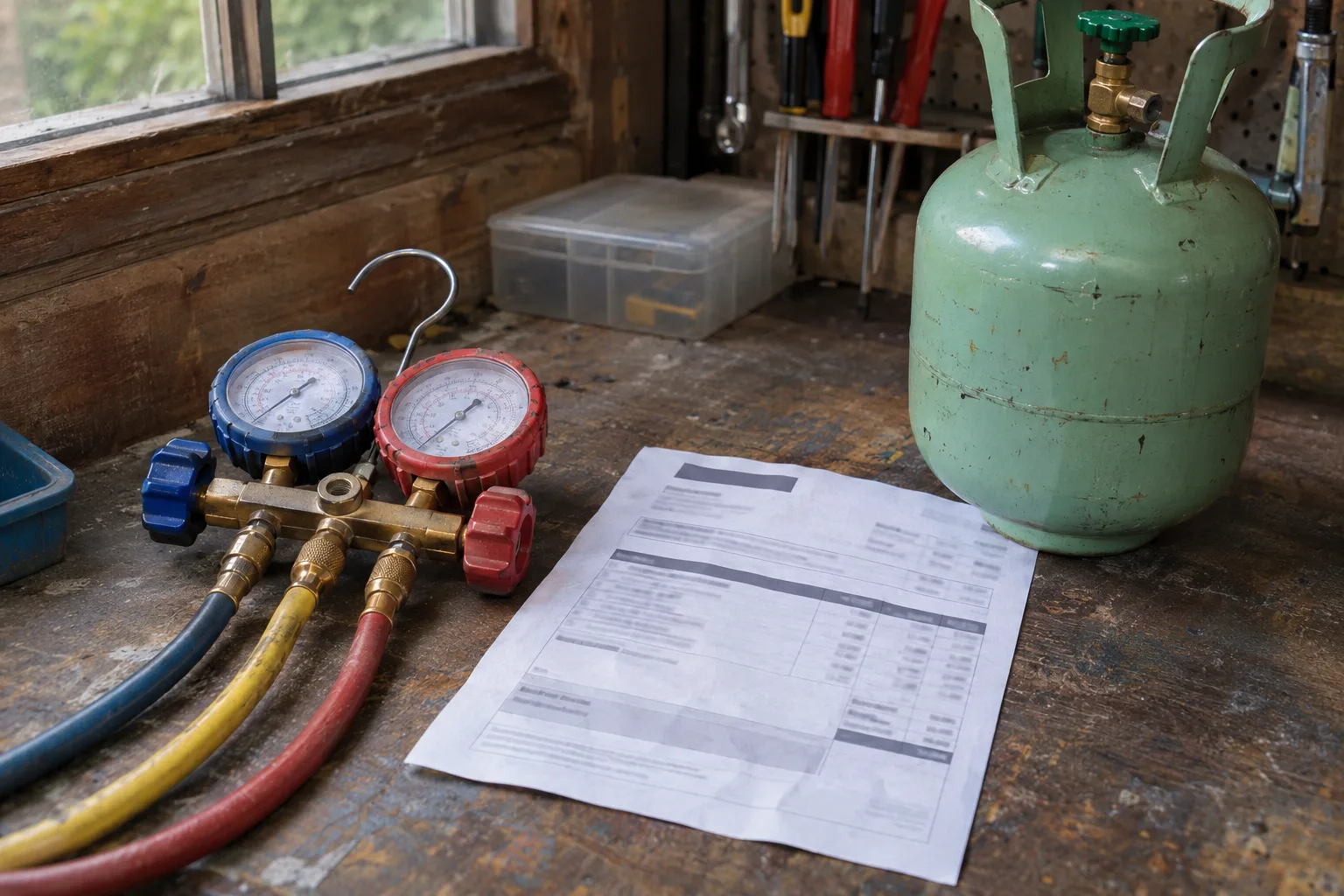
Refrigerant is a material line priced by the pound with the type named - R-410A or R-454B - never a vague "charge" line. Leak ranges show why the sequence is documented: Fixr reports $200 to $1,600 averaging near $800, and Angi $250 to $1,500 against a recharge alone at $100 to $500. A recharge without a leak search is a temporary fix, and the estimate should say so.
Step 8: Add commissioning as its own line
Commissioning is not a courtesy or part of "install." It makes the equipment perform to its rating, and it is billable work with a deliverable:
- Superheat and subcool, measured and recorded.
- Supply and return static pressure.
- Measured airflow against the design value.
- Combustion analysis on gas equipment.
- Thermostat staging verified.
Put the readings on the invoice when the job closes. That record settles a performance complaint next summer.
Step 9: Permits, inspections and access
Permits and inspections are real costs on changeouts and are not dropped to look cheaper. List the jurisdiction's fee as a pass-through, and your labor to pull it and meet the inspector separately - see HVAC permit costs. Access is the other line contractors absorb: attic heat, a crawlspace you cannot stand up in, a roof unit or a crane set are all materially longer jobs.
Step 10: Tax, total, terms and signature
Show a material subtotal, a labor subtotal, pass-through fees, tax and the total. Then the terms: validity period, that it covers the stated scope and anything found after demolition will be quoted first, how additional work gets approved, labor warranty against the manufacturer's equipment warranty, and the diagnostic fee if the customer declines. Get a signature or documented approval before ordering.
Common mistakes
- One bundled "system installed" number with nothing itemized.
- Equipment lines with no capacity or efficiency.
- Refrigerant as a lump sum, not pounds and type.
- Permit and inspection left out.
- Attic, crawlspace or roof access treated as free.
- A tonnage sold off the old nameplate with no load calculation.
To move faster through these steps, see HVAC estimate software, or start from the HVAC estimate template.
Frequently asked questions
What should an HVAC estimate include?
Customer and service address; existing equipment make, model, serial and capacity from the nameplate; the scope in plain words; equipment as material lines with capacity and efficiency; installation labor in hours at your rate; refrigerant by the pound with the type named; sealed-system labor broken out; commissioning; permit and inspection fees; access and crane charges; tax; the total; validity period; and a signature line.
Can I quote a replacement from photos alone?
You can build the equipment and labor framework from photos. You cannot set the capacity from them. A photo tells you what is installed, which may be the wrong size already. Confirm the tonnage with a Manual J load calculation and say on the estimate that capacity is subject to it before the equipment is ordered.
Why separate equipment from installation?
Because a bundled number is unverifiable and reads as padding. Published replacement ranges are wide - Angi shows $5,000 to $22,000 for a full system - so a homeowner comparing single numbers cannot tell equipment tier from scope from margin. Separate lines let you win on what is included rather than on price alone.
Do I have to list the permit on the estimate?
If the job needs one, yes, as its own pass-through line with your labor to pull it and meet the inspector shown separately. Burying it in labor means you absorb the difference whenever the jurisdiction's fee is higher than you assumed, and dropping it entirely makes your quote look cheaper than a compliant one for the wrong reason.
Sources
- Angi - HVAC replacement cost 2026
- Fixr - Central air conditioner repair cost 2026
- Angi - Freon leak repair cost
- Trane - Pricing guide
Estimates and invoices in minutes
HVAC Service Estimator turns a photo into an itemized estimate, then an invoice. Free to download.
More in for shops