HVAC estimate software
Updated 2026-11-07 · By the HVAC Service Estimator team
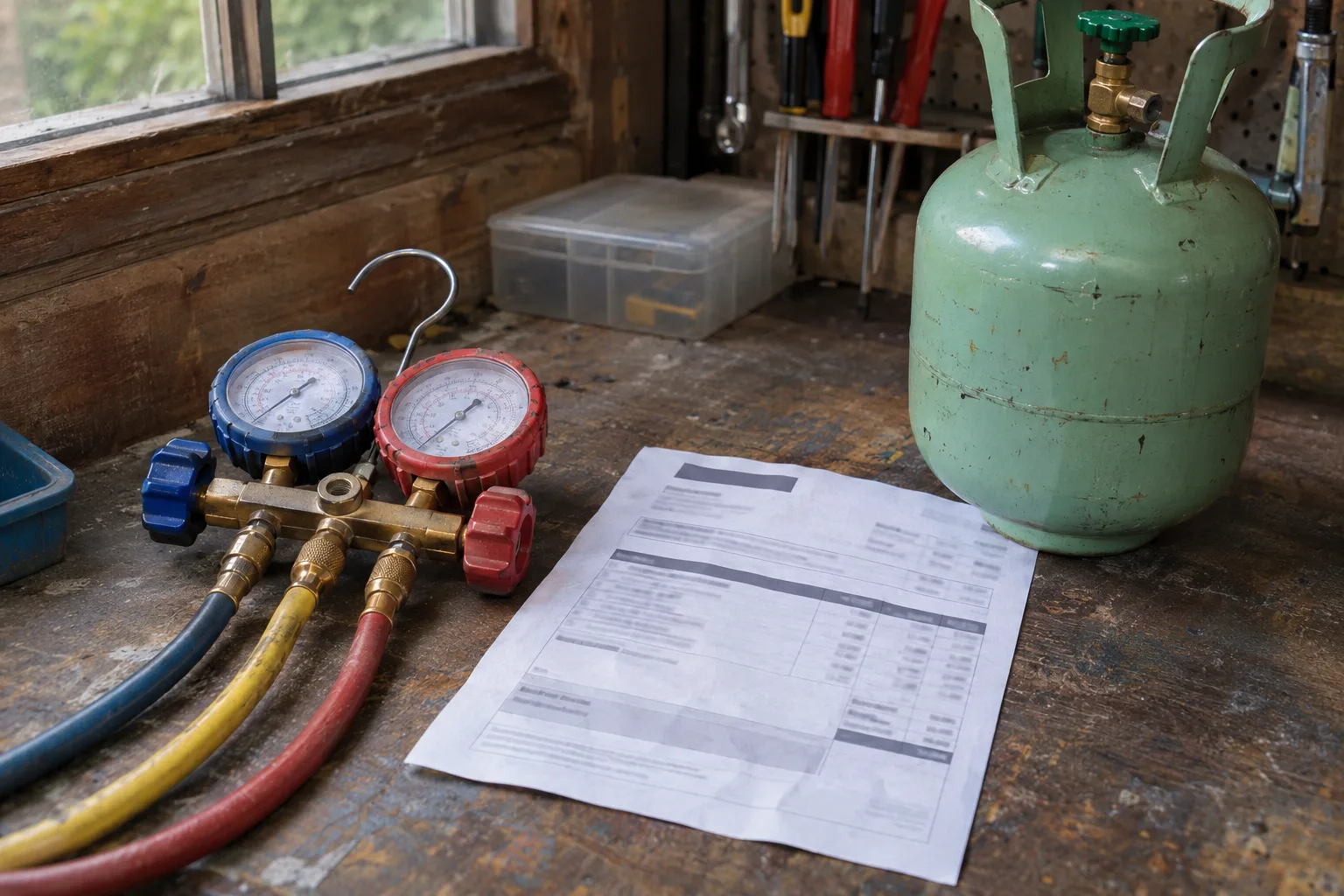
Most HVAC estimating tools were built for office work: sit at a desk, open a job, type line items. The jobs happen in attics and crawlspaces. A photo-to-estimate app closes that gap - photograph the nameplate, the air handler and the lineset, dictate what you found, and get back an itemized estimate with equipment, labor, refrigerant and commissioning on separate lines, ready to send before you leave the driveway.
What the app does on a job
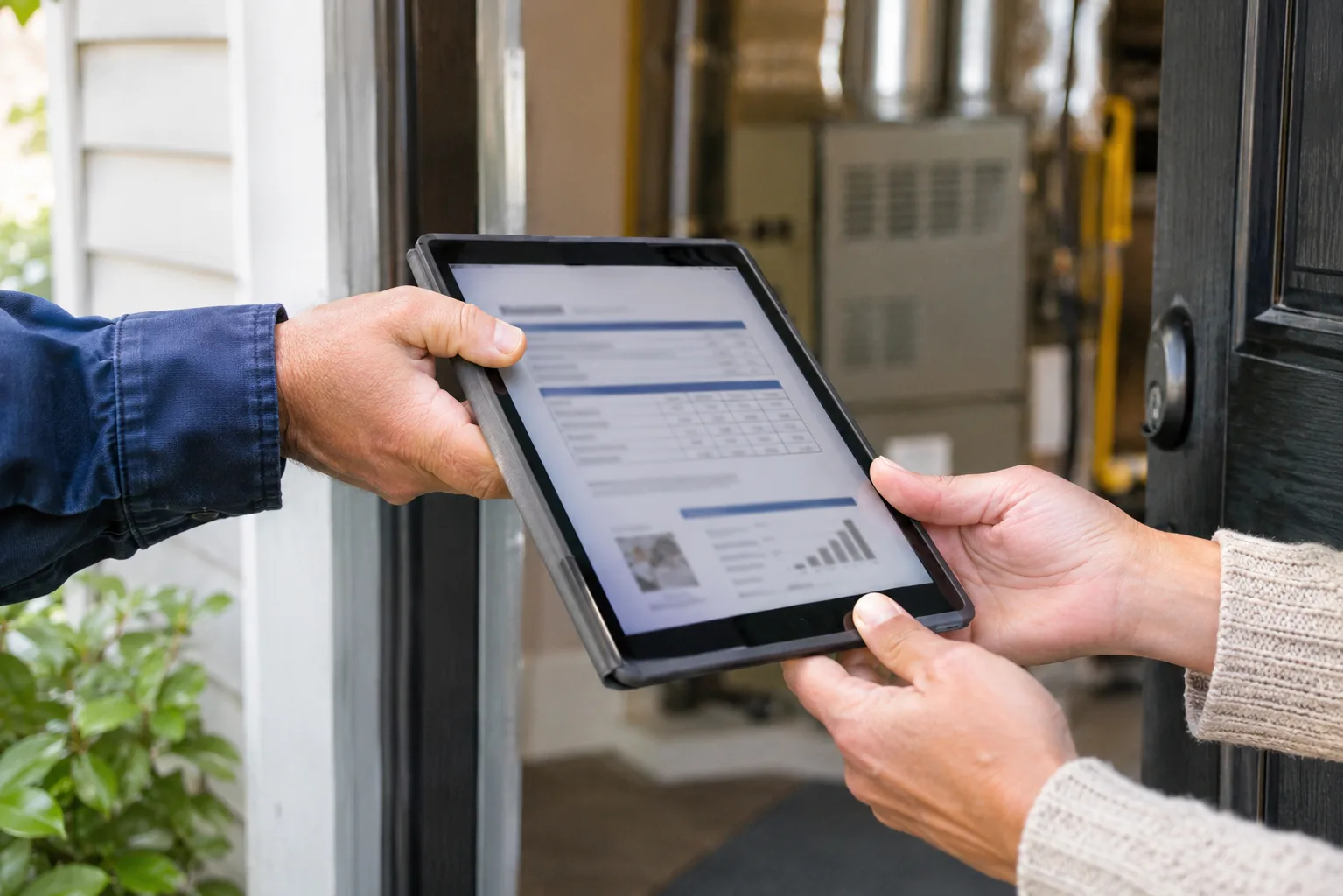
You are standing at a condenser that is not running. You photograph the data plate, the disconnect, the indoor unit and the lineset where it enters the wall, then dictate what you found: contactor pitted, capacitor reading low, 2015 R-410A system, attic air handler. The app returns an itemized estimate you can edit, send and later convert to an invoice.
The lines come back the way a contractor writes them, not the way a generic invoicing app does:
- Equipment as material, with capacity in the description, so "3-ton condenser, 14.3 SEER2" appears rather than "outdoor unit."
- Installation as labor, in hours at your own rate, on its own line.
- Refrigerant by the pound, with the type named: R-410A or R-454B.
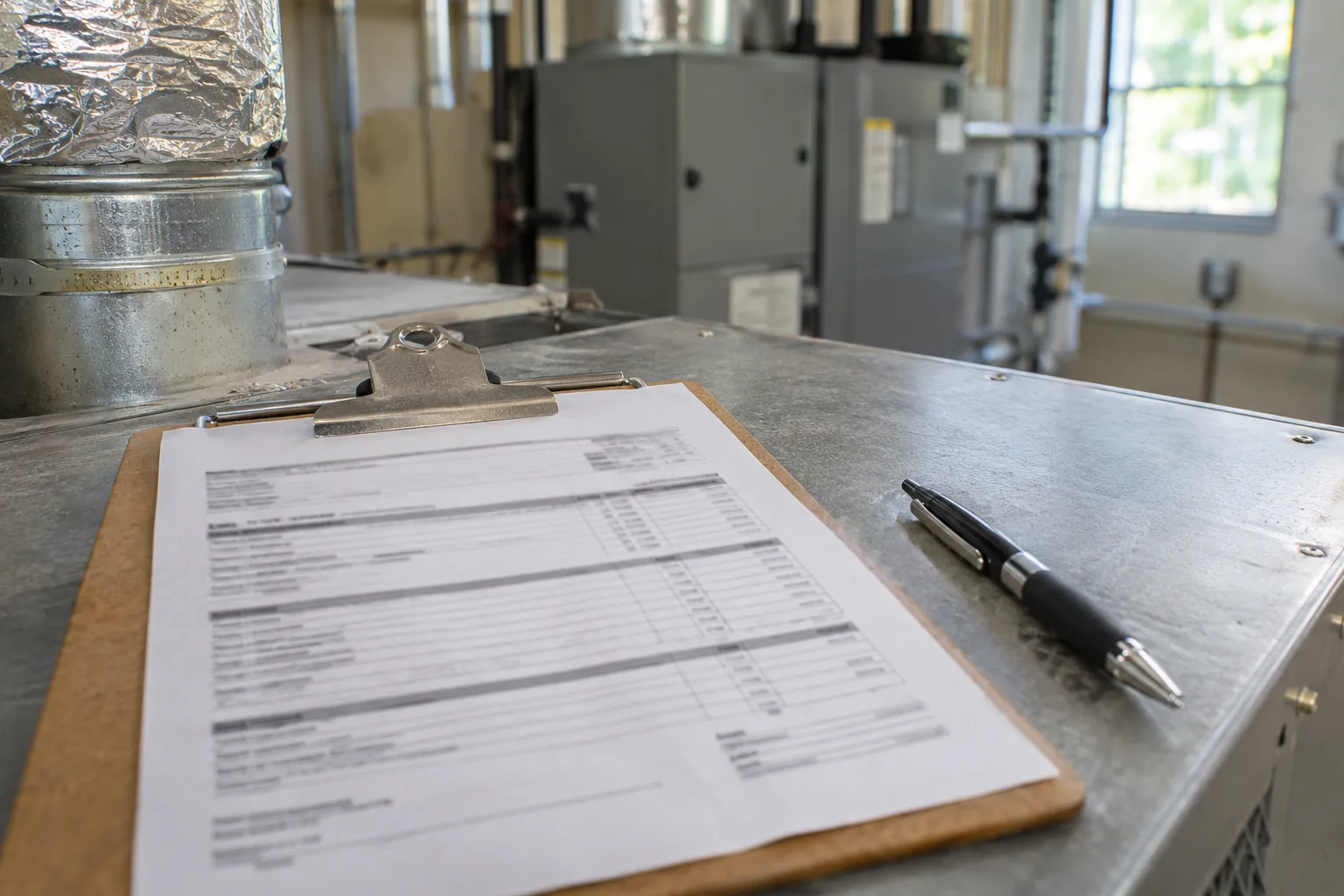
- Commissioning as its own line, covering superheat and subcool, static pressure, airflow, and combustion analysis on gas equipment.
- Permits and inspections, listed as pass-through cost rather than absorbed.
- Access and crane or lift charges where the attic, crawlspace or roof makes the job longer.
- The diagnostic or service call fee, carried onto the estimate when the visit started as a service call.
Why bundling kills the sale
A homeowner comparing three quotes cannot evaluate three different single numbers. Published cost data shows why the spread is so wide: Angi puts a full system replacement at about $7,500 on average with a range of $5,000 to $22,000, and aggregated 2026 guides put the common band at $7,000 to $15,000. A homeowner who gets $9,400 from you and $11,200 from the next contractor has no way to tell whether the difference is equipment tier, duct modification, a permit you included, or margin.
Itemize and the conversation changes. The homeowner sees that your quote includes a permit and inspection, a new line set, and a commissioning line with measured results, while the cheaper one does not. That is a comparison you can win. A bundled number is one you can only defend on price.
Equipment lines with capacity in the description
Every unit on the estimate carries its capacity and efficiency, because those are the two facts that determine the price and the two the homeowner will be asked about later by an inspector, a utility rebate program or the next contractor.
| Line type | Written as | Not as |
|---|---|---|
| Condenser | 3-ton condenser, 14.3 SEER2, R-454B | New AC unit |
| Air handler or coil | 3-ton evaporator coil, matched, cased | Indoor unit |
| Furnace | 80,000 BTU gas furnace, 80% AFUE, single-stage | Furnace |
| Heat pump | 2.5-ton heat pump, variable-speed, with backup heat kit | Heat pump system |
| Refrigerant | R-454B, 4 lb, weighed in | Refrigerant charge |
| Installation | Changeout labor, 10 hr, two techs | Included |
For scale on the equipment side, Trane's own pricing guide lists an 80% single-stage gas furnace at $5,093 to $5,481, and Angi puts gas furnace replacement at $3,800 to $10,000 before ductwork, gas line work or a thermostat. Heat pumps are where published sources diverge most sharply: one 2026 guide shows $4,200 to $7,600 while Trane's guide shows $7,369 to $15,608. When sources disagree that much, quote your own supplier cost, not a national figure.
The sealed system sequence, on its own lines
Any job that opens the refrigerant circuit has a fixed sequence, and each step is labor somebody pays for. An estimate that collapses it into "repair leak" loses the argument about why the job costs what it does.
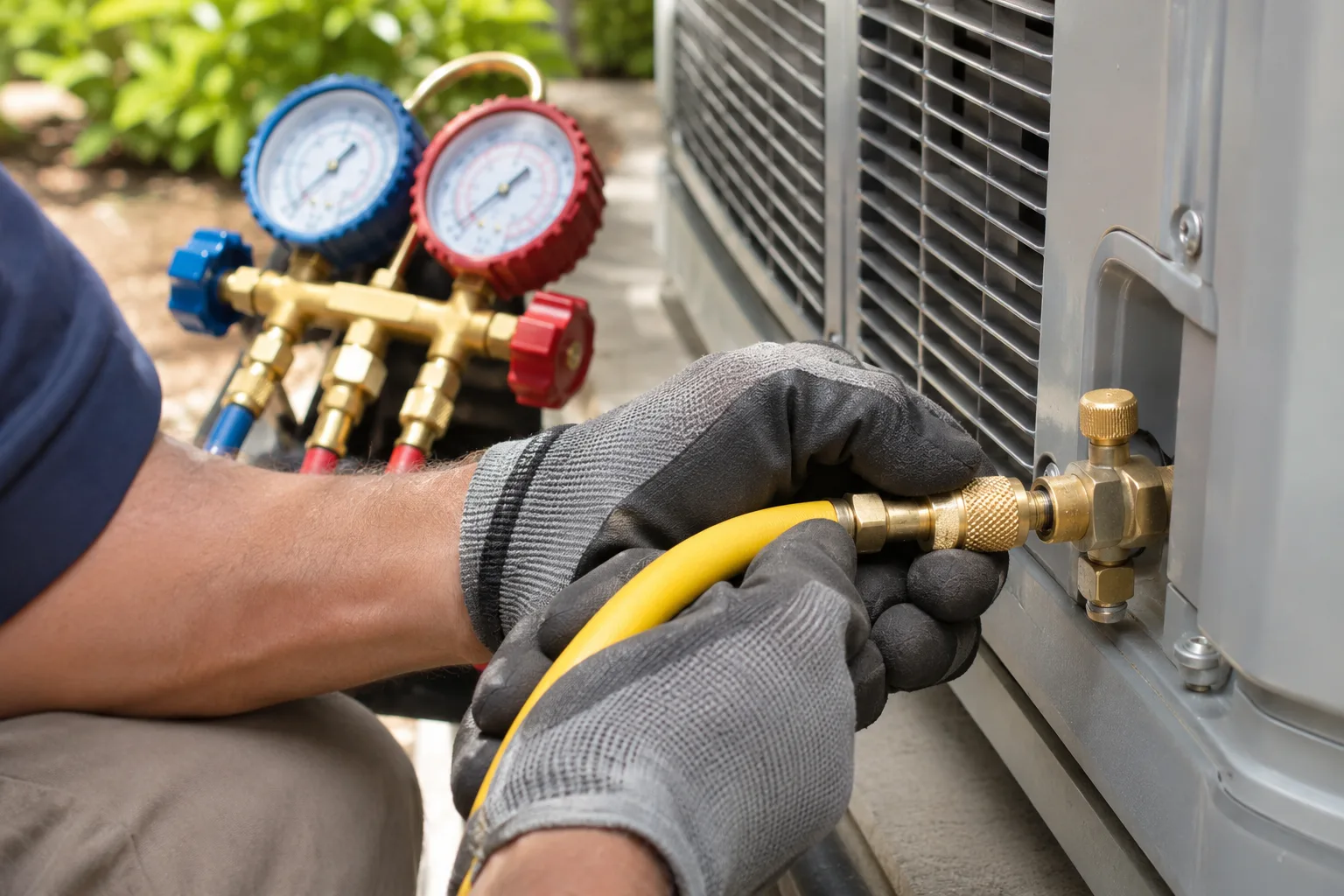
- Recover the existing charge with recovery equipment, by an EPA 608 certified technician.
- Braze the repair or new connections, pressure-testing with dry nitrogen to confirm the joints hold.
- Evacuate to 500 microns and confirm the vacuum holds with the pump isolated.
- Weigh in the charge to the nameplate value, adjusted for lineset length.
Leak work is also where published cost ranges are widest, which is a reason to show your work. Fixr puts refrigerant leak repair at $200 to $1,600 with an average near $800; Angi shows $250 to $1,500 with a recharge alone at $100 to $500; Homeyou reports an average of $837 within a $479 to $1,389 band. The estimate that lists recovery, brazing, nitrogen test, evacuation and weighed charge separately explains its own position in that range.
Repair estimates and the R-22 conversation
On repair calls the app builds the same itemized structure at smaller scale. Fixr puts overall central AC repair at $375 on average with most jobs between $250 and $700. Component work sits inside that: Fixr shows capacitors at $100 to $400 with an average near $175 and This Old House shows $150 to $400 parts and labor, while compressor work runs far higher - Angi shows $800 to $3,000 and Homeyou reports $1,679 to $3,687 with an average of $2,487.
That compressor range is the number that drives the honest conversation on an older system. On an R-22 machine, a like-for-like sealed-system repair is no longer practical: the refrigerant is out of production, what remains is expensive and inconsistent in supply, and a repaired 20-year-old system is still a 20-year-old system. Write the repair estimate if the customer wants it, and write the replacement estimate beside it, with both itemized so the comparison is real.
Estimate through to invoice
An approved estimate becomes the work order, and the work order becomes the invoice without retyping. The commissioning line is where the invoice earns its keep: fill in the measured superheat, subcool, static pressure and airflow, and the combustion analysis results on gas, and you have a record that the system was set up rather than merely installed. That record is what you want on file when a homeowner calls in August of next year.
See HVAC invoice software for the billing side, how to write an HVAC estimate for the full step-by-step, and HVAC service call rates for pricing the diagnostic visit that starts most of this work.
Frequently asked questions
Can software size a system from a photo?
No, and you should not trust anything that claims to. A photo tells you what is installed now, which is a starting point, not a sizing decision. Replacement capacity is confirmed with a Manual J load calculation that accounts for the building envelope, window area, orientation, infiltration and duct losses. The photo gets you the model and serial so you know what you are replacing; the load calculation tells you what to install.
How should equipment and installation appear on an estimate?
On separate lines. Equipment is a material line with the capacity in the description, for example "3-ton condenser, 14.3 SEER2." Installation is labor, priced in hours at your rate. A bundled "system installed" figure gives a homeowner nothing to evaluate and reads as padding, which is exactly the objection you do not want to answer by phone.
Does an estimate need to list refrigerant separately?
Yes, by the pound and by type. R-410A and R-454B are different products at different costs, and the quantity depends on lineset length and system charge. A line that reads "R-454B, 4 lb" is checkable. A line that reads "refrigerant" is not, and it hides the single most volatile material cost in the trade.
Is a photo estimate accurate enough to sell from?
It is accurate enough to price the work you can see and verify, which is most service and repair work. On a changeout, treat the photo estimate as the equipment and labor framework and confirm capacity with a load calculation before the equipment is ordered. Say so on the estimate rather than discovering the disagreement on install day.
Sources
- Angi - HVAC replacement cost 2026
- Fixr - Central air conditioner repair cost 2026
- Trane - Pricing guide
Estimates and invoices in minutes
HVAC Service Estimator turns a photo into an itemized estimate, then an invoice. Free to download.
More in for shops