Estimating software for HVAC contractors
Updated 2026-11-07 · By the HVAC Service Estimator team
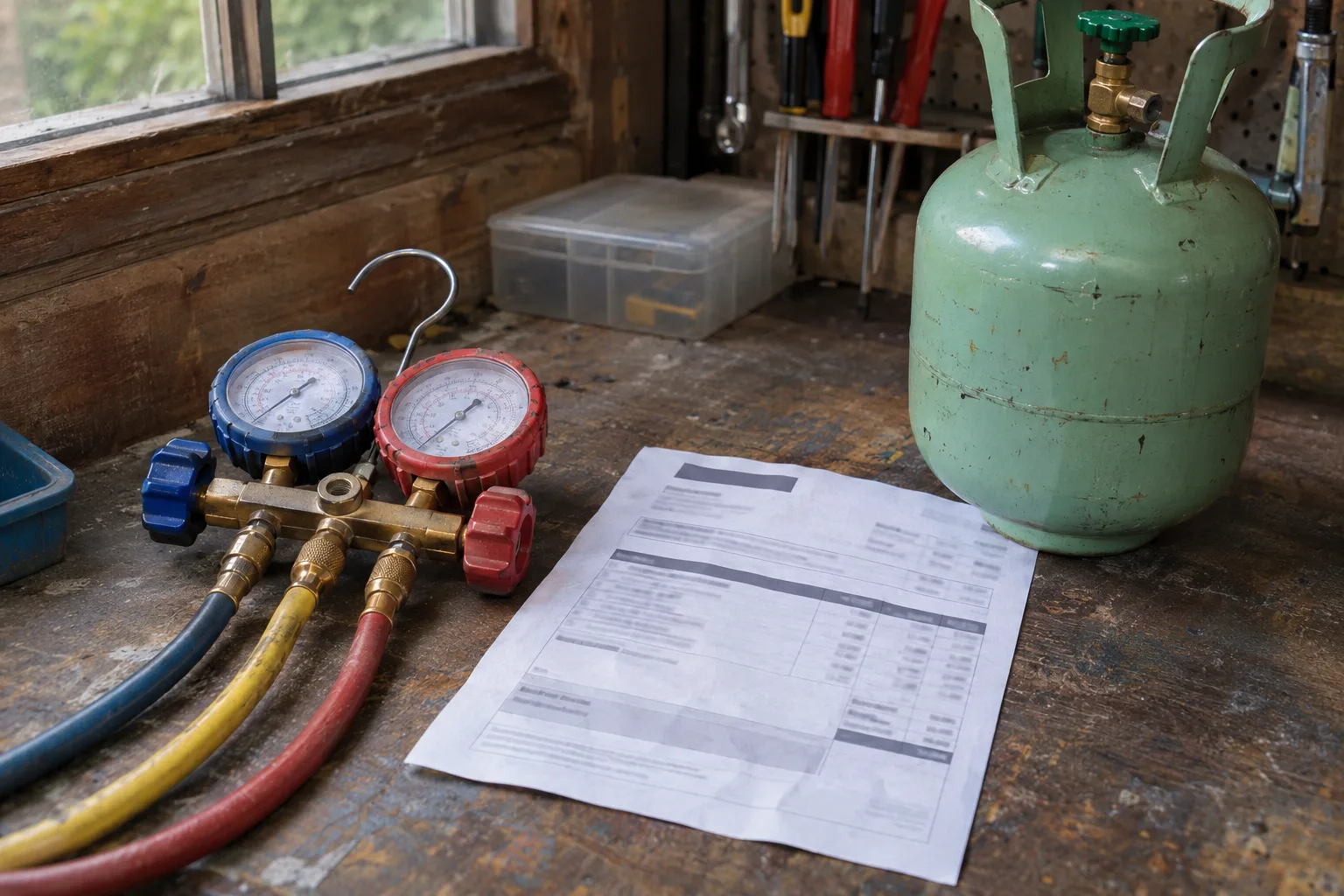
An HVAC contractor already runs software: a dispatch and service platform for the board, load calculation software for design, a supplier portal for equipment pricing. A photo-to-estimate app is not a replacement for any of those. It covers the part of the day those tools handle badly - the tech standing in a crawlspace who needs an itemized number in front of the customer before the next call.
What the existing software stack does well
Nothing on this page suggests dropping tools that work. A contractor running three or more trucks needs:
- A dispatch and service platform for the board, technician assignment, call history and recurring maintenance agreements.
- Load calculation software for Manual J, and duct design where you are doing it properly.
- Supplier portals for live equipment and parts pricing, availability and warranty registration.
- Accounting, which is where invoices eventually need to land.
Those systems are built for the office and the schedule. They are not built for a technician on a ladder with one hand free.
The gap in the middle of the day
A working HVAC day produces a steady stream of moments that need a number right now:
- A no-cool call where the capacitor is bad and the customer wants to know the repair price before authorizing it.
- A 19-year-old R-22 system where a repair quote and a replacement quote need to sit side by side, today, while you are still in the house.
- A maintenance visit that turned up a cracked heat exchanger and a condemned furnace.
- A homeowner who sends three photos and asks for a ballpark before booking anything.
- A property manager with four units who wants separate itemized quotes by Friday.
In each case the cost of going back to the office to write it up is the job. The customer calls someone else, or they say yes to a verbal number you then have to defend on an invoice.
How the app handles a visit
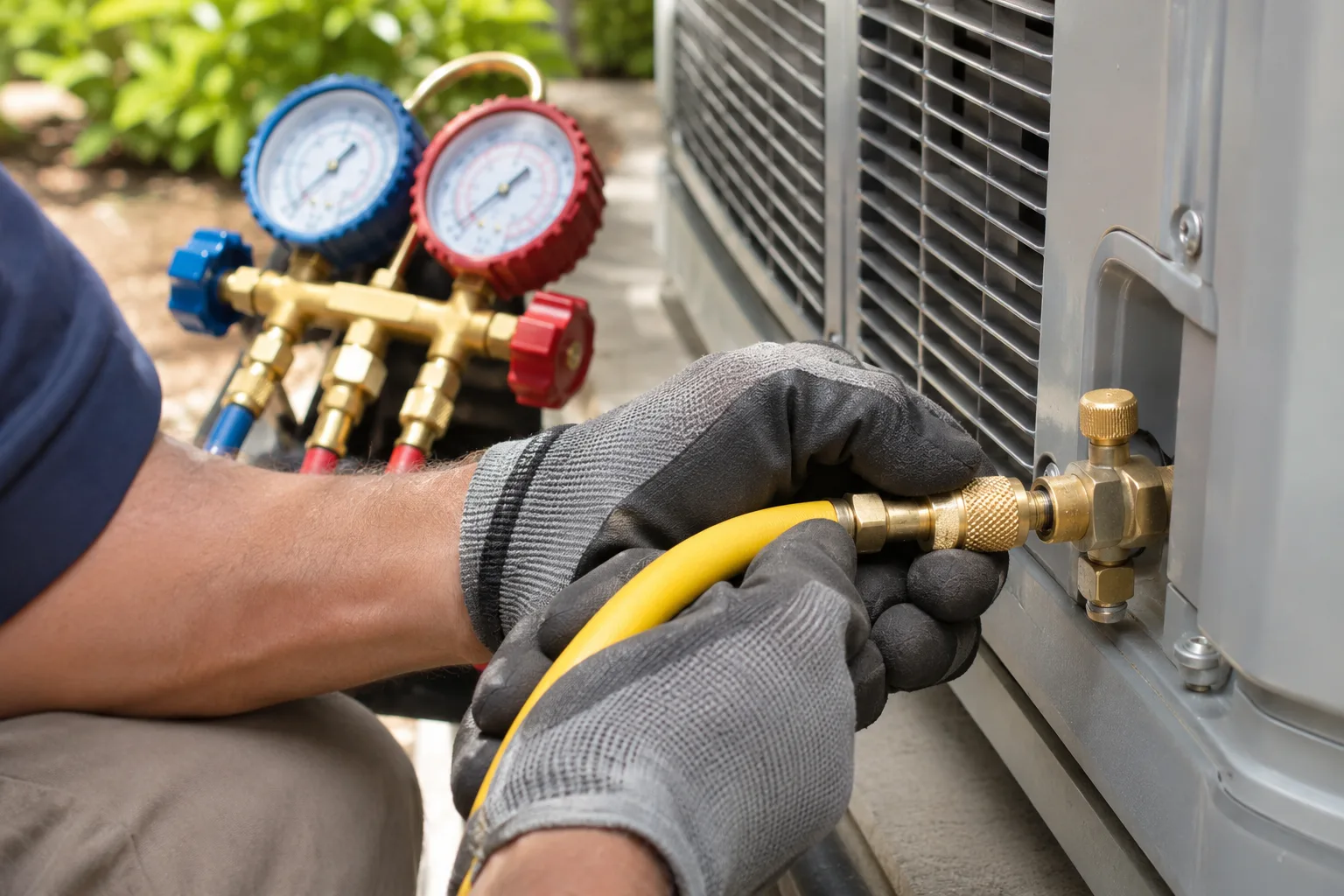
Photograph the data plate, the indoor unit, the lineset, the electrical and whatever is actually wrong. Dictate what you found in trade language. The estimate comes back itemized in the structure the work has:
| Element | How it appears |
|---|---|
| Diagnostic visit | Service call fee as a labor line, carried from the call |
| Equipment | Material line with capacity: "3-ton condenser, 14.3 SEER2" |
| Installation | Labor line in hours at your rate, never folded into equipment |
| Refrigerant | Per pound, type named: R-410A or R-454B |
| Sealed system work | Recover, braze and nitrogen test, evacuate to 500 microns, weigh in charge |
| Commissioning | Superheat and subcool, static pressure, airflow, combustion analysis on gas |
| Permit and inspection | Pass-through fee plus labor to pull and meet the inspector |
| Access | Attic, crawlspace, roof or crane as separate labor |
Send it as a link or PDF under your company name, get approval, and convert it to an invoice when the work is done. See HVAC estimate software for the detail on each line type.
Where itemizing earns the job
Replacement pricing is where homeowners shop hardest and where the published ranges are widest. Angi puts a full system replacement at about $7,500 on average across a $5,000 to $22,000 range, and aggregated 2026 guides put the common band at $7,000 to $15,000. Central AC alone runs $3,900 to $7,900 installed per 2026 guide data, and Angi shows gas furnace replacement at $3,800 to $10,000 before ductwork, gas line work or a thermostat. Trane's own pricing guide lists an 80% single-stage gas furnace at $5,093 to $5,481.
Heat pumps are the clearest case for not quoting a national average at all: a 2026 guide shows $4,200 to $7,600 while Trane's guide shows $7,369 to $15,608. Those sources are describing different equipment tiers and different scopes. Your itemized estimate, with the actual model, the actual capacity and your actual labor, is the only number that means anything to the customer in front of you.
What it does not do
- It does not size equipment. Capacity is confirmed by a Manual J load calculation. A photo shows what is installed, which is frequently the wrong size already - inheriting a previous contractor's mistake is not a design method.
- It does not replace the dispatch board. Multi-truck scheduling, maintenance agreement renewals and crew management stay where they are.
- It does not write engineered commercial bids. Submittals, drawings and multi-trade coordination need project estimating software.
- It does not know your supplier's price this week. You set equipment pricing and labor rates.
Fitting it into an existing process
Service and repair, start to finish
For most repair calls the app covers the whole job: diagnostic fee, parts, labor, invoice, paid. Fixr puts central AC repair at $375 on average with most jobs between $250 and $700, which is the band where the overhead of a full office write-up costs more than it returns.
Changeouts up to the design step
Build the itemized framework in the house while the customer is engaged - equipment with capacity, labor, refrigerant, permit, commissioning, access. Confirm the capacity with a load calculation before ordering. The customer has a real document the same day and the design still happens properly.
Repair-versus-replace conversations
Two itemized estimates beside each other, both honest. On an R-22 system be straight about it: like-for-like sealed-system repair is no longer practical, because the refrigerant is out of production and supply is both expensive and inconsistent. Compressor figures make the case on their own - Angi shows $800 to $3,000 and Homeyou reports $1,679 to $3,687 with an average of $2,487. Spending that on a twenty-year-old R-22 machine rarely makes sense, and an itemized pair of estimates shows it rather than asserting it.
Remote quoting
Ask for photos of the data plate, the indoor unit and the electrical, then build a conditional estimate that states what still needs to be verified on site. It is enough to decide whether to book the visit.
Next
Set your rates with the HVAC labor rates guide, price the diagnostic visit with HVAC service call rates, and see for owner-operator HVAC if you are running one truck.
Frequently asked questions
Does this replace our dispatch or service management system?
No. A dispatch platform owns the schedule, the board, the technician assignments and the customer history across a crew. A photo-to-estimate app sits inside a single visit: photograph, dictate, produce an itemized estimate, send it, convert it to an invoice. If you run multiple trucks on a dispatch board, keep the board.
Can it do a Manual J load calculation?
No, and it does not pretend to. A load calculation needs the building: square footage by zone, construction and insulation values, window area and orientation, infiltration, duct location and losses. None of that is visible in a photo of a condenser. Use load calculation software for sizing and this for pricing what you decided to install.
Is it useful for commercial work?
Partly. Light commercial service and rooftop unit repair work the same way residential does - photograph the unit, price the repair, itemize it. Full commercial projects with engineered drawings, submittals, bid documents and multiple trades need project estimating software, not a phone app.
What about equipment pricing - does it know our supplier cost?
You set your own equipment pricing and labor rates. Supplier cost on HVAC equipment moves with refrigerant transition, tier and availability, and no app should be inventing a number for a unit you are buying this week. The app's job is structure and speed, not guessing your distributor's price.
Sources
- Angi - HVAC replacement cost 2026
- Trane - Pricing guide
- Fixr - Central air conditioner repair cost 2026
Estimates and invoices in minutes
HVAC Service Estimator turns a photo into an itemized estimate, then an invoice. Free to download.
More in for shops