
HVAC equipment markup
Updated 2026-11-07 · By the HVAC Service Estimator team
Markup on HVAC equipment is not a surcharge for handling a box. It pays for the capital you tie up in inventory, the warranty labor you perform for free, the returns and the restocking, and the risk of carrying a unit a customer changes their mind about. The mistake is not marking equipment up - it is hiding the marked-up equipment inside a bundled installation price, where the customer cannot evaluate it and you cannot defend it.
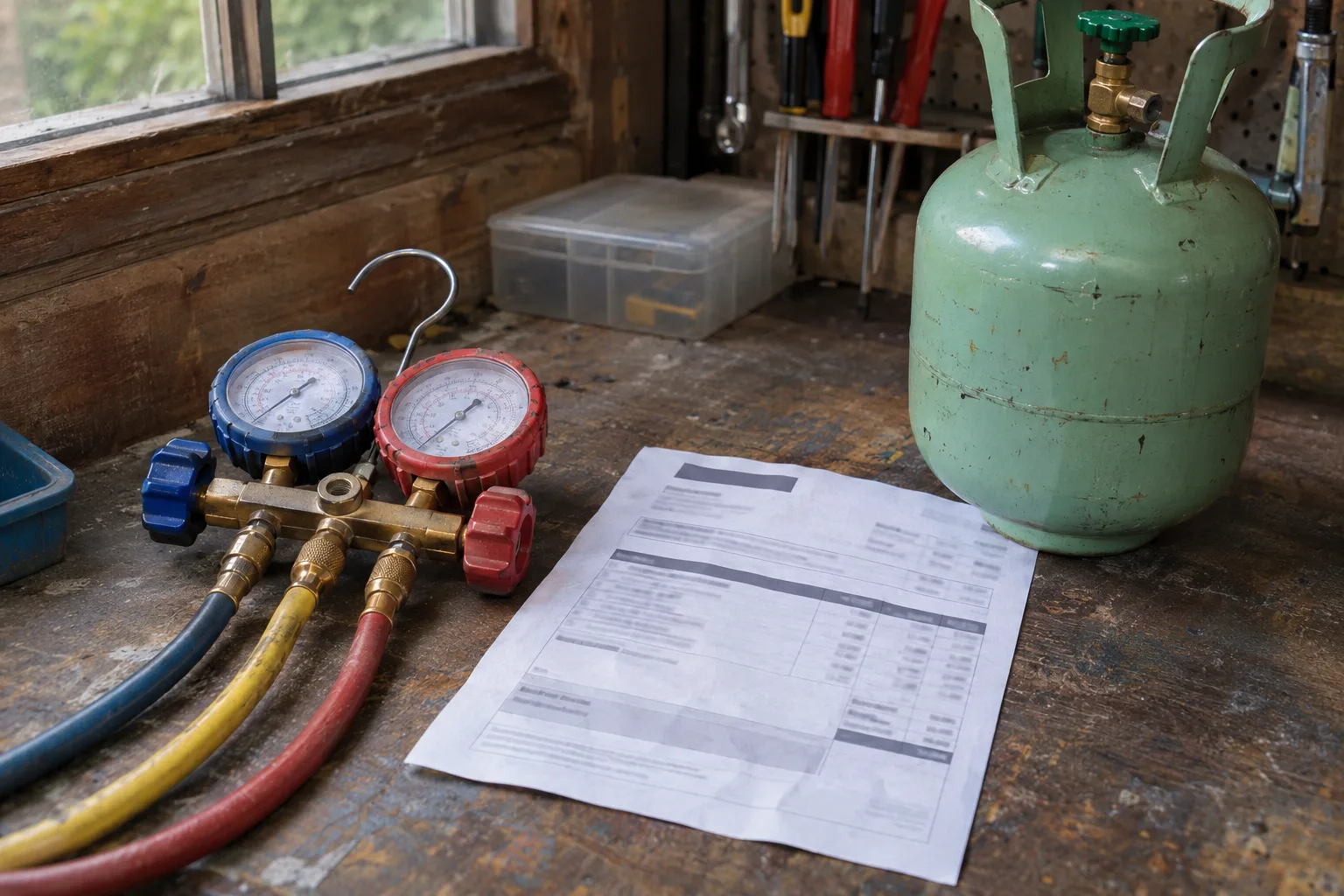
What the markup actually pays for
Customers who object to equipment markup usually imagine it is a fee for picking up a box. The real costs behind it are less visible and considerably larger:
- Capital tied up in inventory. Units, coils, furnaces and refrigerant on the truck or in the shop are money you have already spent and not yet collected.
- Warranty labor. Manufacturers cover the part. You cover the trip, the diagnosis and the installation labor, often for years. That cost has to come from somewhere, and it comes from the margin on equipment.
- Returns and restocking. Wrong size, wrong voltage, cancelled job, restocking fees, and a trip back to the supply house.
- Warranty registration and administration. Filing registrations against model and serial numbers, and keeping the records that make a claim payable.
- Freight and handling damage. A dented coil case is yours to argue about.
- Price volatility. Equipment quoted today and installed in three weeks may cost more by then, particularly during a refrigerant transition.
- Target margin on materials. A business that makes money only on labor has no cushion at all in a slow season.
Equipment is a material line. Installation is labor.
This is the structural rule and it is worth being inflexible about. Equipment gets a material line with its capacity in the description. Installation gets a labor line in hours at your rate. They are never a single figure.
| Material line | Separate labor line |
|---|---|
| 3-ton condenser, 14.3 SEER2, R-454B | Changeout labor, hours at install rate |
| Matched 3-ton evaporator coil, cased | Coil replacement labor, hours |
| 80,000 BTU gas furnace, 80% AFUE, single-stage | Furnace install labor, hours |
| 2.5-ton heat pump with 10 kW backup heat kit | Install labor plus electrical, hours |
| 3/4 in x 3/8 in lineset, 30 ft, insulated | Lineset routing and brazing, hours |
| R-454B, 4 lb | Recover, nitrogen test, evacuate to 500 microns, weigh in |
| Condensate pump and trap | Condensate labor, hours |
| Non-fused disconnect, 60 A, with whip | Electrical labor, hours |
The reason to hold this line is the published spread. Angi puts a full system replacement at about $7,500 on average across a $5,000 to $22,000 range, and aggregated 2026 guides put the common band at $7,000 to $15,000. Central AC alone runs $3,900 to $7,900 installed per 2026 guide data. A homeowner cannot locate your quote inside a range that wide without seeing what is in it.
Capacity in the description, every time
A material line without capacity is not a quote, it is a placeholder. "Condenser - $4,200" could be a 2-ton builder-grade unit or a 4-ton variable-speed machine, and the homeowner has no way to tell. "3-ton condenser, 14.3 SEER2, R-454B - $4,200" is comparable, checkable, and the basis for a conversation about tier rather than price.
This is also the honest way to present a good-better-best option set. Three itemized estimates with different capacities, efficiencies and stage counts show the customer what the extra money buys. Three bundled totals just look like three guesses.
Refrigerant: by the pound, type named
Refrigerant deserves its own treatment because it is the most volatile material cost in the trade and currently mid-transition. R-410A and R-454B are different products with different prices, different handling requirements and different supply conditions. A line reading "R-454B, 4 lb" survives a cost increase - you change the per-pound figure. A line reading "refrigerant charge - $340" does not, and it invites the suspicion that the number was made up.
On R-22 systems, this is also where the repair-versus-replace conversation becomes concrete. The refrigerant is out of production, remaining supply is expensive and inconsistent, and a like-for-like sealed-system repair is no longer practical. A per-pound line for R-22, priced at what it actually costs you to obtain, usually ends that debate without you having to argue it.
Where published equipment figures help and where they do not
Manufacturer and aggregator figures are useful as a sanity check, not as your price. Trane's own pricing guide lists an 80% single-stage gas furnace at $5,093 to $5,481, and Angi shows gas furnace replacement at $3,800 to $10,000 before ductwork, gas line work or a thermostat. Heat pumps show how far sources can diverge: a 2026 guide gives $4,200 to $7,600 while Trane's guide gives $7,369 to $15,608, a gap that reflects different equipment tiers and different scopes rather than disagreement about the same job.
The practical conclusion is to quote from your distributor's current price, marked up by your own calculation, with the capacity and efficiency on the line. Do not price a unit from a national average, and do not let a customer price your work from one either - itemizing is what lets you explain the difference.
Markup on parts and small materials
Repair work has the same structure at smaller scale. Capacitors, contactors, motors, igniters, flame sensors, control boards and filter driers each get a material line and carry their own markup, with the labor to install them priced separately. Small consumables - brazing rod, nitrogen, mastic, tape, sealant, fasteners - can reasonably go into a named materials line rather than being counted individually, but it should be a named line, not something quietly absorbed into labor hours.
What not to do
- Do not bundle. A single "system installed" figure is the one presentation a customer cannot evaluate and you cannot defend.
- Do not hide markup in labor hours. Inflating hours to recover material margin corrupts the only number you use for scheduling and for pricing future jobs.
- Do not drop the permit to look cheaper. Permits and inspections are real costs on changeouts; see HVAC permit costs.
- Do not discount equipment to win a job. Cutting the material line cuts the margin that funds your warranty labor on that exact system for the next several years.
- Do not quote a capacity you have not confirmed. Sizing comes from a Manual J load calculation, never from a photo of what is already installed.
Set the labor side with the HVAC labor rates guide, and see HVAC estimate software for producing these lines on site rather than in the evening.
Frequently asked questions
What is a standard HVAC equipment markup?
There is no figure here, because no source we are willing to cite publishes a credible current one, and contractor practice varies with volume, supplier terms and what the markup is covering in each business. Calculate it from what it has to pay for: inventory cost, warranty labor, returns, and your target margin on materials.
Should equipment markup be visible on the estimate?
The marked-up price should be visible as a material line with the capacity in the description. The markup percentage itself does not need to be broken out - no trade shows its cost basis. What matters is that the equipment price and the installation labor are separate numbers the customer can compare against another quote.
Why not just quote one installed price?
Because a single number is unverifiable and reads as padding. Published replacement ranges run from $5,000 to $22,000 per Angi, so a homeowner comparing two bundled numbers cannot tell equipment tier from scope from margin. Itemizing is how you show that your quote includes a permit, a new lineset and commissioning when the cheaper one does not.
How should refrigerant be marked up?
By the pound, as a material line with the type named. R-410A and R-454B are different products with different costs and different supply conditions, and refrigerant is the most volatile material cost in the trade. A per-pound line with the quantity shown stays defensible as costs move; a lump "refrigerant" line does not.
Sources
Estimates and invoices in minutes
HVAC Service Estimator turns a photo into an itemized estimate, then an invoice. Free to download.
More in for shops